
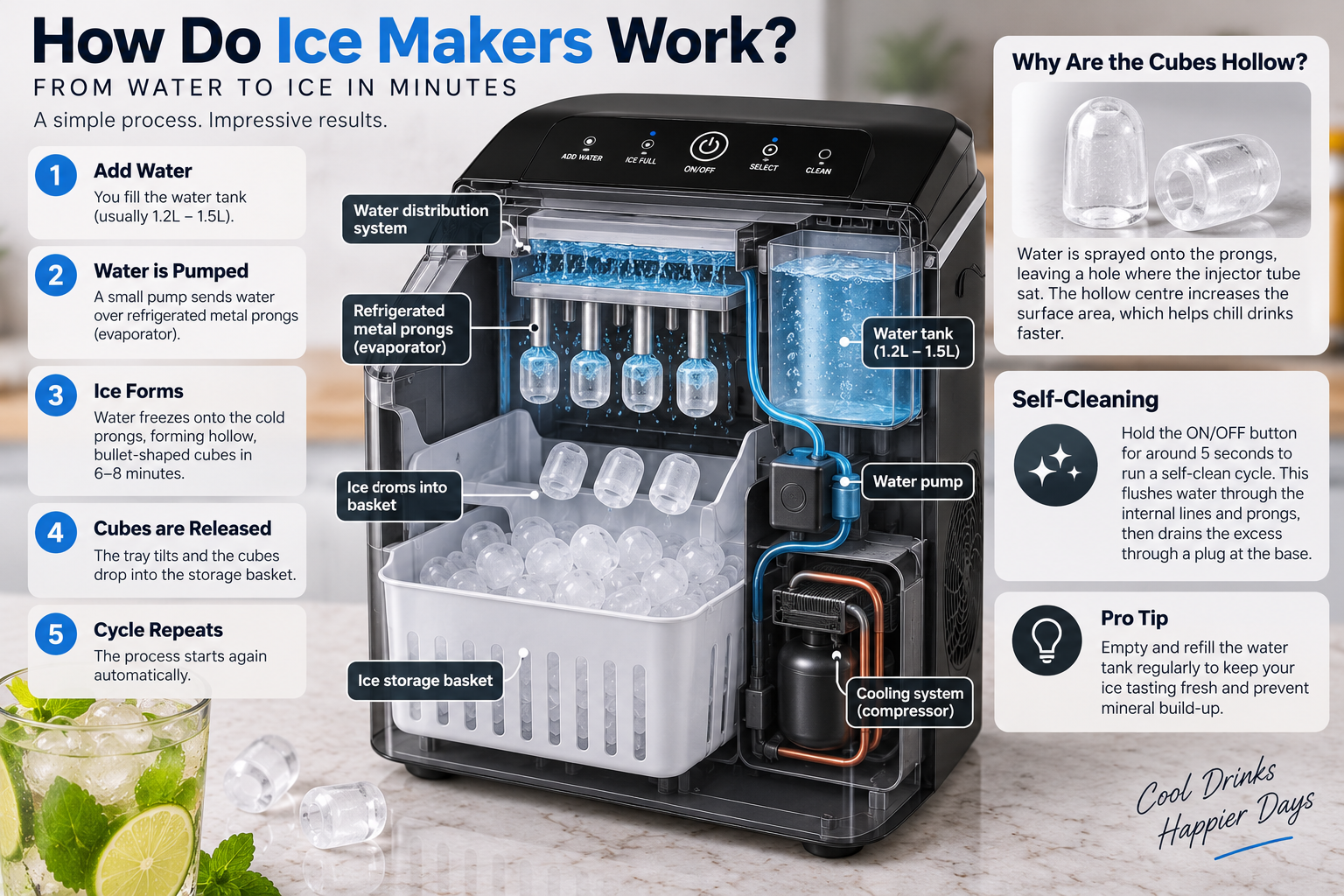
How Do Ice Makers Work? Cleaning, Maintenance and Common Problems
The quick answer
- Basic mechanism: water is pumped over refrigerated metal prongs, which freeze it into bullet-shaped cubes in minutes rather than hours.
- Cleaning: most countertop machines, including the PALINTH, have a self-clean cycle triggered by holding the power button for several seconds.
- Most common problem: stale-tasting ice, almost always caused by leaving unused meltwater sitting in the recycling tank too long.
The basic mechanism
Unlike a freezer, which chills an entire compartment slowly over hours, a countertop ice maker uses a small refrigerated set of metal prongs (an evaporator) that water is pumped over continuously. As water flows over the cold prongs it freezes in place, forming the hollow bullet-shaped cubes typical of this category. Once a cycle finishes, the machine tips or releases the tray so the cubes drop into the storage basket, and the cycle repeats — which is how a batch of 9 cubes can be ready in 6–8 minutes rather than the hours a freezer tray takes.
Why the cubes are hollow
The bullet shape isn’t just cosmetic, it’s a side effect of how the water is sprayed onto the prongs, leaving a hole where the injector tube sat. That hollow centre actually increases the ice’s surface area, which is why bullet ice melts a little faster than a solid cube from a freezer tray, and why makers recommend using it soon after it’s made rather than banking a large reserve.
Self-cleaning: what it actually does
Most modern countertop ice makers, PALINTH included, trigger a self-cleaning cycle by holding the ON/OFF button for around five seconds. This runs water through the internal lines and prongs to flush out mineral build-up and any residue, finishing by draining the excess through a plug in the base. Doing this every few weeks — more often in hard water areas — keeps the ice tasting clean and prevents scale building up on the evaporator prongs.
The most common complaint: stale-tasting ice
By far the most frequent real-world issue reported by owners isn’t a fault — it’s how these machines are designed to work. When ice isn’t removed and used, most countertop makers recycle the meltwater back into the internal tank rather than keeping cubes frozen solid, since there’s no separate freezer compartment. Left for a day or two, that recycled water can pick up a stale taste. The fix is simple: empty the machine and refill with fresh water if you’re not using it daily, rather than leaving it topped up and idle.
Other common problems and fixes
- Machine shows “ice full” but the basket looks empty: usually a sensor misread caused by water sitting where the ice should be — empty the basket fully and let a fresh cycle run.
- Ice takes far longer than 6–8 minutes: check the water level first, since running low triggers a slower or interrupted cycle; also make sure the unit isn’t in direct sun or too close to a heat source.
- Cubes are smaller or misshapen: worth checking the size selector wasn’t accidentally left on a mismatched setting, and that the water tank is topped up to the recommended line.
- Lid won’t stay open during loading: a minor but common gripe on budget models — most have a simple prop mechanism that needs to click into a stop rather than being left to rest freely.
Maintenance checklist
- Run the self-clean cycle every 2–4 weeks (more often in hard water areas)
- Empty and refresh the water tank if the machine goes unused for more than a day
- Wipe the ice basket and transparent lid to prevent residue build-up
- Keep the unit away from direct sunlight and heat sources for consistent cycle times
- Use fresh, cold water for each fill rather than topping up stale water
Quick FAQ
Why does my ice maker’s ice taste odd after a day or two? Nearly always because the machine recycles unused meltwater rather than keeping cubes frozen. Empty and refill regularly if you’re not using it daily.
How often should I run the self-cleaning cycle? Every 2–4 weeks under normal use, and more frequently if you’re in a hard water area, since mineral scale builds up faster on the evaporator prongs.
Why are the ice cubes hollow in the middle? It’s a result of how water is sprayed onto the freezing prongs during the bullet-ice process, not a fault — the hollow centre is standard for this type of machine.