Prices are what I found at the time of writing and change often. Amazon availability and dispatch for the Go-Anywhere varies, so check that it ships from Amazon UK or a UK-based seller.
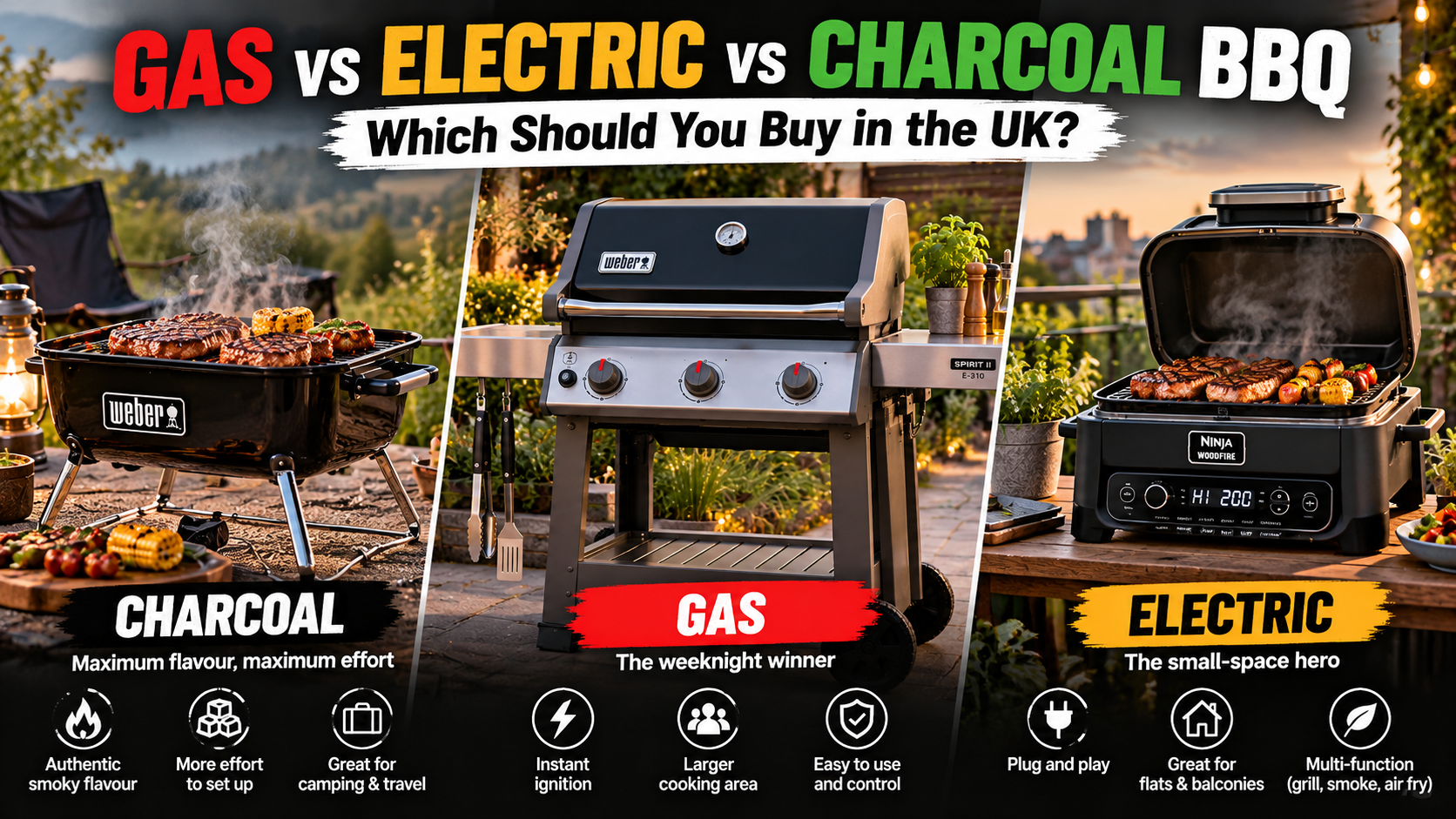
Charcoal: maximum flavour, maximum effort
Charcoal gives the most traditional smoky flavour, and the Weber Go-Anywhere is a good, cheap example: a 42 × 26cm grill with folding legs for camping, picnics and small gardens.
The catch: you have to light it, wait, manage the vents, then let it cool and dispose of the ash. Rainy weekday evening? Not ideal.
Safety: never use a charcoal BBQ indoors, in a tent or in a garage. It gives off carbon monoxide.
Gas: the weeknight winner
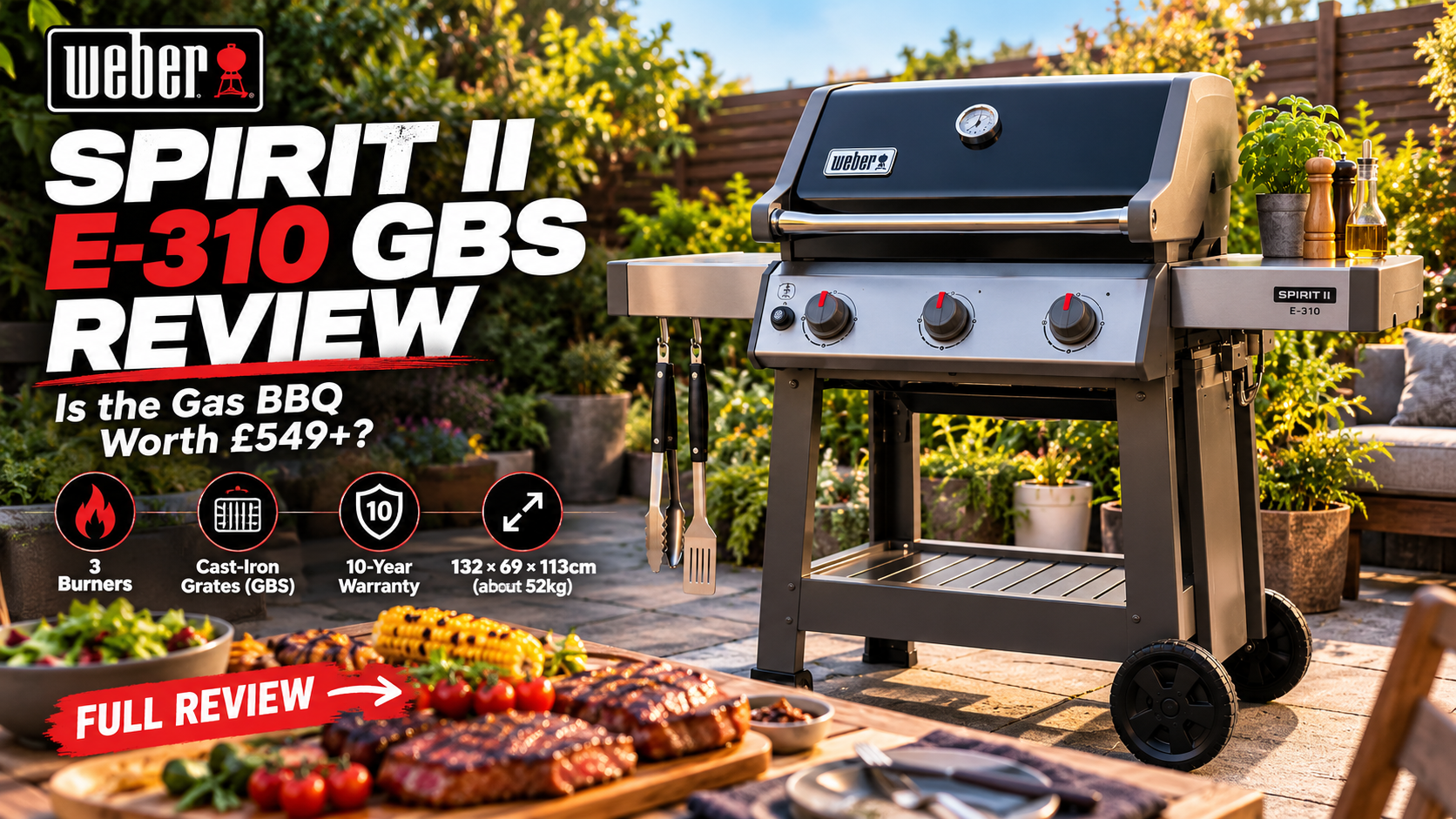
The Weber Spirit II E-310 GBS represents the category well: instant ignition, burner-by-burner heat control and a 10-year warranty listed by UK retailers. Gas is the easiest option for regular use. Light it, wait a few minutes, cook.
The catch: it costs far more than the other two, it’s heavy (about 52kg), and gas doesn’t give you true charcoal flavour.
The Ninja Woodfire OG701UK is an electric grill with a smoker box that burns real wood pellets for flavour. It’s listed as safe for balconies and small patios, which makes it the easiest to fit into a flat, and it also air-fries and bakes.
The catch: it needs a power socket and a small plate (28 × 37cm) limits big parties.
60-second decision guide
Live in a flat with a balcony? Electric. Check your lease first.
Have a garden and BBQ every week? Gas.
Love the taste and the ritual? Charcoal.
Going camping or to the park? Charcoal. It’s the only one that needs no power.
On a tight budget? Charcoal is the cheapest to start with. Fuel costs add up, though.
Cooking for 8 or more regularly? Gas, for the bigger cooking area.
Check before you buy
Read your lease or building rules before buying anything with flames or hot coals, especially in a flat.
Gas grills need a bottle and the right regulator. Confirm before you order.
Electric grills need a safe outdoor power source. Use an outdoor-rated socket or lead and keep connections dry.
Measure your space. The Spirit II E-310 GBS is listed at about 132cm wide.
Quick FAQ
Which gives the most authentic flavour? Charcoal, most people agree. Gas with flavour bars and electric with wood pellets narrow the gap, but don’t match it.
Can I use a gas or charcoal BBQ on a UK balcony? Many leases and building rules restrict open flames. Check yours before you buy.
Which is the most convenient for weeknights? Gas and electric both start instantly. Gas has the bigger cooking area; electric adds air frying and smoking.
Some BBQs last a summer. Weber wants this one to last a decade. The Spirit II E-310 GBS comes with a 10-year warranty listed by UK retailers, and a price tag to match.
So is this three-burner gas grill worth £549 or more?
30-second verdictBuy it if you BBQ most weeks, have a garden or big patio, and want a gas grill that lights instantly and is built to last. Skip it if you’ve got a balcony, a tiny yard, or you BBQ twice a year. The numbers:3 burners · cast-iron cooking grates · 10-year warranty (listed) · RRP £679, typically £549–£649 · 132 × 69 × 113cm · about 52kg. Check the price on Weber UK →
Prices change often, so confirm on the live page.
The specs, at a glance
Weber Spirit II E-310 GBS
Burners
3, stainless steel
Grates
Porcelain-enamelled cast iron (GBS)
Ignition
Infinity ignition
Size
132 × 69 × 113cm as listed (the left side table folds down to save space)
Weight
About 52kg (51.9kg listed)
Warranty
10 years listed by UK retailers
Price
RRP £679; typically £549–£649
Fuel
Bottled gas (LPG). Check the fuel variant before you buy
What testers said
Ideal Home (UK, tested in 2023) liked the quick assembly, solid build, easy-to-use features and the grilling results. Their one negative was the disposable drip tray, which you have to keep buying.
Tom’s Guide (a US review of the US model) called it one of the most popular gas grills around. It liked how easy the grates were to clean. Its cons: uneven temperatures in places, some chicken skin stuck to the grates, and iGrill 3 not included.
In short, great build, easy life, a few small niggles.
What it’s like to live with
Lights at the push of a button and heats in minutes, so it’s the weeknight-friendly option.
Heavy and big. At about 52kg and 132cm wide as listed, measure your patio before you click buy.
Cast-iron grates hold heat well for searing.
Fold-down side table helps with storage.
The catch (read this bit)
It’s an investment. Cheaper gas grills exist. You’re paying for build quality and the warranty.
Uneven heat. Expect to learn its hot and cool spots.
Disposable drip trays are an ongoing cost.
No smart thermometer in the box. It’s compatible with Weber’s iGrill 3, which is sold separately.
You’ll need a gas bottle. Check you have the right regulator and can get refills.
Where to buy
Pick it or skip it
Pick it if
Skip it if
You BBQ weekly from spring to autumn
You BBQ a handful of times a year
You have a garden or large patio
You live in a flat with a balcony
You want a long warranty
You want the cheapest possible gas grill
You hate waiting for charcoal
You love the flavour of charcoal smoke
Quick FAQ
Is it worth the money? If you’ll use it weekly for years, the build and warranty justify it. If not, a cheaper grill makes more sense.
Is a smart thermometer included? No. iGrill 3 is compatible but sold separately.
How big is it? 132 × 69 × 113cm and about 52kg, so measure your space first.
Does it run on bottled gas? Yes, check the listing for the correct fuel variant before you order.
Picture smoky, chargrilled burgers on a small patio. No gas bottle. No charcoal chimney. No open flame. Plug it in, drop a scoop of wood pellets in the smoker box and cook.
30-second verdictBuy it if you have a small outdoor space, or want an easy BBQ with real smoke flavour and no fuss. Skip it if you regularly cook for a crowd, or you want a fully portable, off-grid grill. The numbers:2,400W · 28 × 37cm grill plate · £229–£300 depending on retailer · 2-year guarantee if you register in time. Check today’s price on Amazon UK →
Prices vary between retailers and change often. Check the live listing.
The specs, at a glance
Ninja Woodfire OG701UK
Power
2,400W
Cooking area
28 × 37cm (Ninja says it fits 8 burgers, 16 sausages, 2 racks of ribs or a 2kg pork shoulder)
Size
H34 × W46 × D46cm
Weight
14.75kg
Weather
Water-resistant to IPX4; Ninja says it’s fine to store outdoors
Functions
7-in-1: grill, smoke, air fry, bake, roast, dehydrate and more
Guarantee
2 years if registered within 28 days of purchase
Price
About £229–£300 across UK retailers
How the “wood” in Woodfire works
The heat comes from an electric element. The pellets are there for flavour, not fuel: they burn in a small smoker box, and Ninja’s listing says one scoop is enough to flavour a cook. Two pellet blends are sold: a classic one for meat, and a sweeter one for fish and vegetables.
There is also a low-and-slow smoker mode for bigger cuts like brisket, and an air-fry mode. Ninja’s claim for air-frying is up to 75% less fat than deep-frying, tested against hand-cut chips. That is the brand’s own test, so treat it as a ceiling rather than a promise.
What does it cost to run?
Ninja’s own running-cost calculation assumes a 45-minute cook at 34p/kWh. At the full 2,400W for all 45 minutes, that works out at about 61p (2.4kW × 0.75h × 34p). That is my arithmetic, and it is a worst case, because the element cycles on and off while cooking. Pellets cost extra.
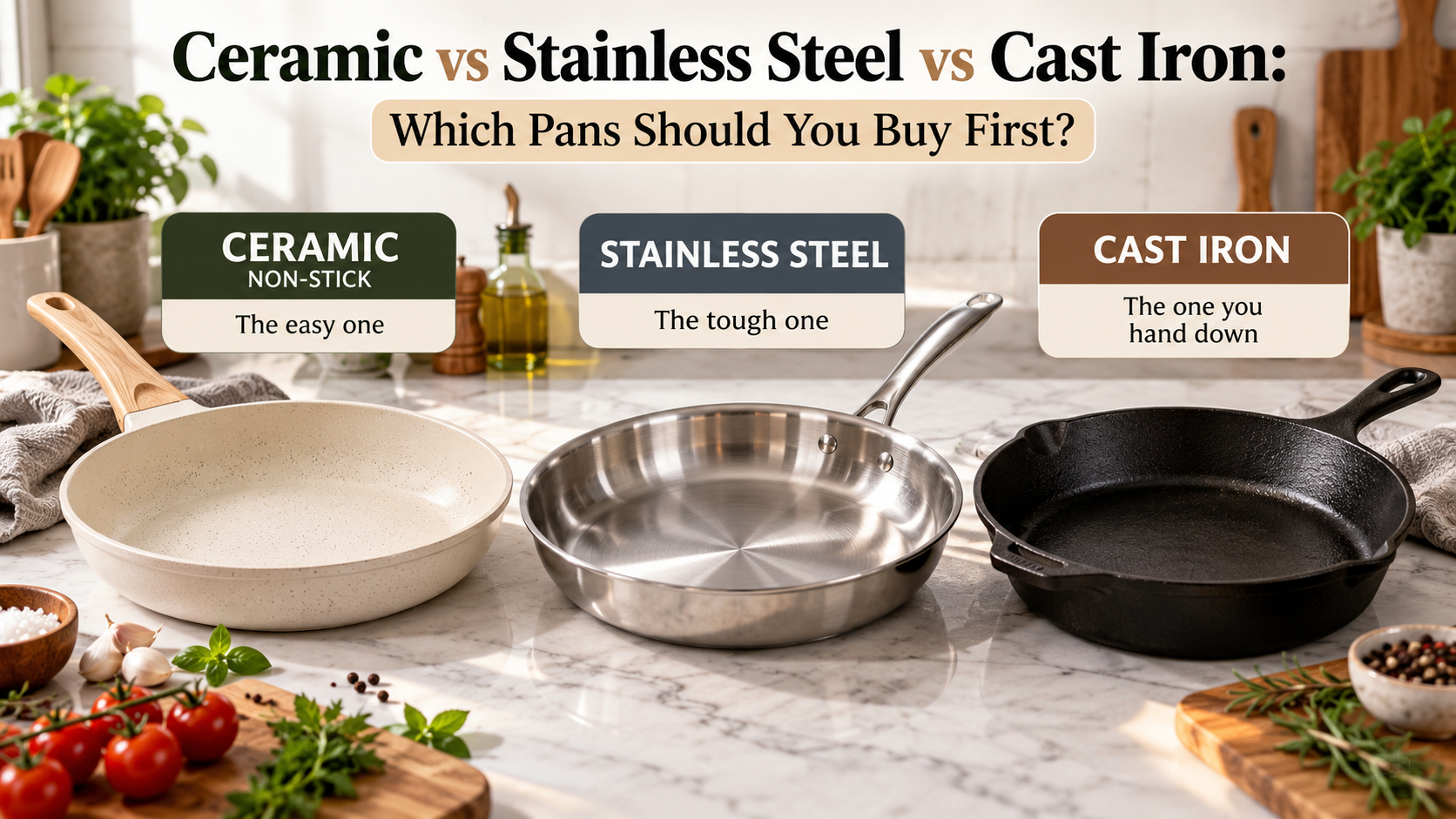
Three pans. Three personalities. One is forgiving, one is tough, one gets better with age. Pick the wrong one for how you actually cook, and you’ll hate your cookware by Wednesday.
CAROTE’s 11-piece set is a good example of the category. It is a granite-style non-stick coating that the brand says is free of PFOS, PFOA, lead and cadmium. You get a 24cm frying pan, two saucepans with lids (18cm/2L and 20cm/2.8L), a 24cm/4.1L stockpot and a 28cm/4.4L saute pan, and it works on induction.
Why beginners love it: food releases with little oil and cleanup is a wipe. The catch: coatings wear. One Amazon UK reviewer said theirs stopped releasing food within two months. Treat coated pans as something you’ll replace every few years, not for life. Keep the heat moderate and the utensils soft.
Cast iron: the one you hand down
Lodge’s skillet is pre-seasoned with vegetable oil, with no synthetic coating. That seasoning is oil baked into the iron, and it gets better the more you cook. It holds heat brilliantly, so it’s the one for searing steaks, and it goes from hob to oven.
Why people love it: it can last generations with basic care. The catch: it is heavy, it needs a quick wipe and oil after washing, and it doesn’t belong in the dishwasher.
Stainless steel: the tough one
Uncoated stainless is the most durable option. It handles metal utensils and high heat, and it’s great for searing and building pan sauces. The Nuovva 8-piece set sits in the middle: a stainless build with an easy-release inner coating, a copper-coloured outside, glass lids and wooden handles.
Why people love it: it looks good and lasts. The catch: uncoated stainless has a learning curve, because food sticks if the pan isn’t properly preheated. A coated version like Nuovva’s is gentler to learn on, but the coating will wear like any other. If you want proper uncoated stainless and avoid nickel, see our HOMI Chef review[insert internal link].
60-second decision guide
Cook eggs, fish, pancakes, and hate scrubbing? Ceramic.
Want one pan for steaks, cornbread, and campfires, and don’t mind weight? Cast iron.
Want the pans to look great on the hob and handle everything? Stainless, or a coated stainless if you’re still learning.
Building a kitchen from scratch on a tight budget? A ceramic set covers the most pans for the lowest upfront cost.
Not sure? Buy a ceramic set for daily use and add one cast iron skillet for searing. That pair covers most home cooking.
Check before you buy
Induction: make sure the listing says induction-compatible. Not every pan is.
Weight: a 10.25″ cast iron skillet is heavy. If you’ve got a wrist injury or a tiny kitchen, hold one in a shop first.
Oven limits: check the maximum oven temperature on the specific product, especially with glass lids and wooden handles.
Dishwasher: cast iron, no. Coated pans, check the listing. Hand-washing makes any of them last longer.
Quick FAQ
Which is easiest for a complete beginner? Ceramic non-stick. It forgives heat and oil mistakes while you learn.
Does cast iron really outlast the others? With care, yes. Coatings wear over years; iron doesn’t.
Can I put them in the dishwasher? Cast iron, no. Coated pans vary, so check the listing. Hand-washing is the safest bet for all three.
If you’ve searched “home hero knife set” looking for an affordable way to upgrade from mismatched kitchen knives, Home Hero’s block sets are a consistently popular budget pick on Amazon UK. Here’s how the range actually breaks down and which size makes sense.
The Home Hero 7-piece set (Black, with Knife Block) is positioned specifically as a starter set for new kitchens — the brand markets it directly at students, young professionals, and anyone moving into their first home. The 5-piece version covers a chef’s knife, bread knife, carving knife, utility knife, and paring knife, each with a protective sheath, plus a 2-stage sharpener to maintain the edge over time. Blades are high carbon stainless steel, offering solid corrosion resistance and edge retention for the price point.
Build and design
Home Hero’s knives use fully serrated stainless steel blades designed to cut effortlessly through meat, alongside the standard straight-edge blades for general prep. Ergonomic handles are a consistent theme across the range, aimed at comfortable extended use rather than just short bursts of chopping. Protective sheaths are included with the smaller sets, useful for safe storage in drawers or shared kitchens where a full block isn’t practical.
Where it sits against the step-up option
If you want a genuinely integrated sharpening system rather than a separate sharpener tool, the Ninja Foodi StaySharp Knife Block is the natural next step up — its block has a built-in sharpener slot, so you lock a blade in and draw it through to restore the edge, rather than using a handheld sharpener. It typically retails around £169.99 but is very frequently discounted to the £110–£135 range, and the entry 5-piece K32005UK version with scissors is the most direct comparison to Home Hero’s sets. The trade-off is price: even discounted, Ninja’s set usually costs two to three times what a comparable Home Hero set does.
Which one should you actually buy?
First kitchen, tight budget? Home Hero’s 5- or 7-piece sets cover the essentials without a big outlay.
Want an integrated sharpening system and don’t mind paying more? The Ninja Foodi StaySharp Knife Block bundles storage and sharpening into one block.
Sharing a kitchen or limited drawer space? Home Hero’s individually sheathed knives store more flexibly than a fixed block if you don’t have block-sized counter space.
A few things worth checking before you buy
Check whether you’re buying the 5-piece or 7-piece Home Hero set — the piece count and included accessories vary between listings.
Hand-wash to preserve the edge — high carbon stainless blades generally last longer with hand care over dishwasher use.
If considering Ninja’s StaySharp block, watch for sales — the price swings significantly between its £169.99 RRP and frequent Black Friday-style discounts.
Quick FAQ
What’s the difference between the 5-piece and 7-piece Home Hero sets? The 5-piece set covers chef, bread, carving, utility and paring knives with a sharpener; the 7-piece adds a knife block and additional accessories for storage.
Do Home Hero knives come with a sharpener? Yes, the sets include a 2-stage sharpener to maintain the blade edge over time, separate from the knives themselves.
Is the Ninja Foodi StaySharp Knife Block worth the extra cost over Home Hero? It depends on priorities — Ninja’s integrated sharpening block is a genuine convenience upgrade, but at 2–3x the price of a comparable Home Hero set, it’s a step up in cost as well as features.
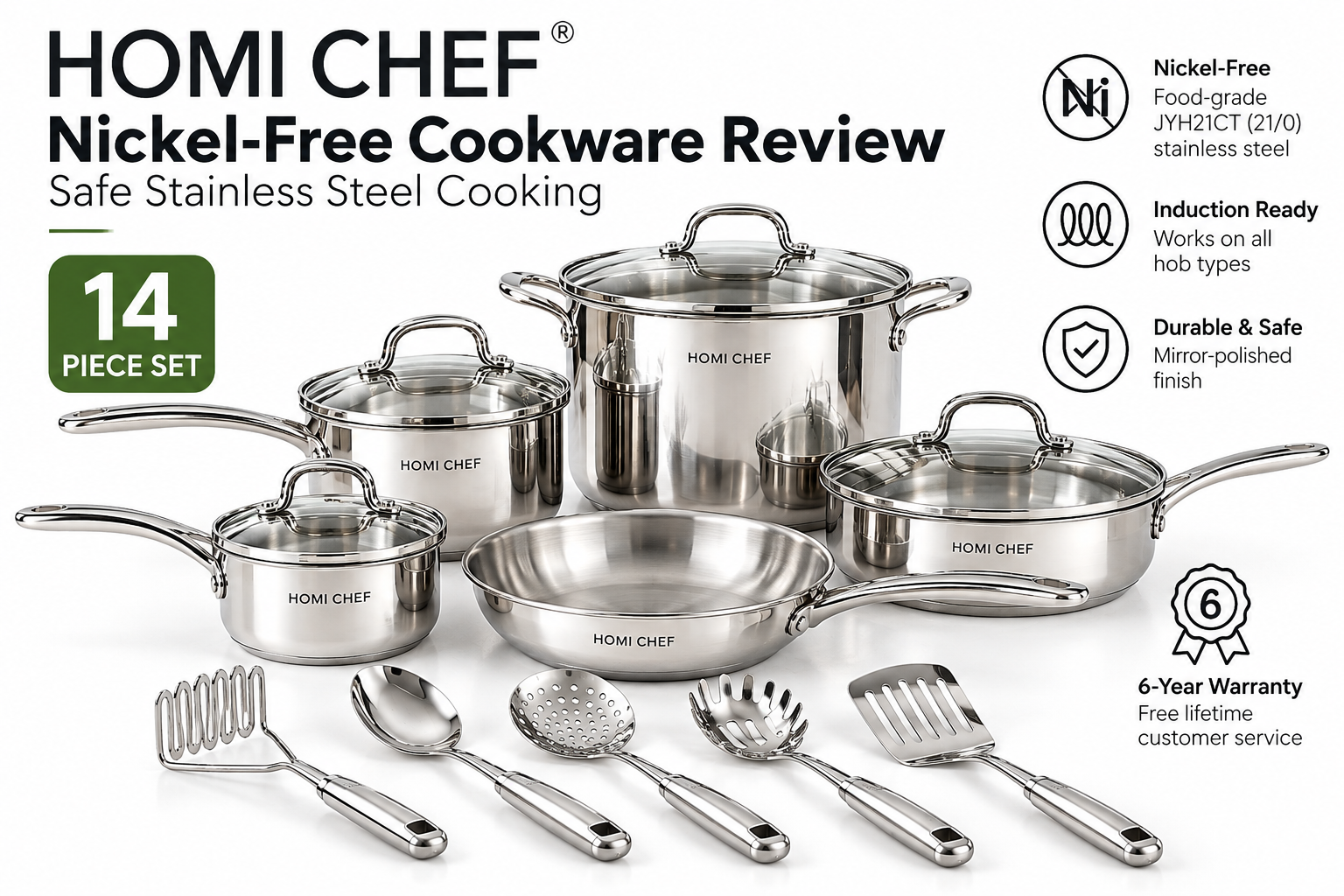
If you’ve searched “nickel free pans” because of a known nickel sensitivity, or simply want to avoid trace metal leaching from everyday cookware, HOMI Chef’s 14-piece set is one of the more established options in the UK market. Here’s what the set actually includes and why the nickel-free claim matters.
Genuinely nickel-free: made from food-grade JYH21CT stainless steel (21/0), not the nickel-bearing 18/8 or 18/10 grades used in most cookware.
Backed by a long warranty: comes with a 6-year warranty and free lifetime customer service from HOMICHEF.
What’s actually in the set
The 14-piece set includes a 1.5QT covered saucepan, a 2.5QT covered saucepan, an 8QT covered stockpot, an 8″ fry pan, a 9.5″ covered saute pan, and five cooking utensils (a potato masher, solid spoon, pasta fork, slotted turner, and skimmer). It’s designed to cover the full range of everyday cooking — searing, frying, simmering and braising — without needing to buy pieces separately.
Why “nickel-free” actually matters
Most stainless steel cookware on the market is made from 18/8 or 18/10 grade steel, both of which contain nickel for corrosion resistance. Nickel is listed high on the ATSDR priority toxin list, and it’s known to leach into food under normal cooking conditions, particularly with acidic ingredients like tomatoes or vinegar-based sauces. For the estimated 1 in 10 people with a nickel sensitivity, this can trigger a reaction from something as ordinary as cooking dinner. HOMICHEF’s cookware uses food-grade JYH21CT stainless steel (21/0) instead, which is genuinely free of nickel while retaining the durability and finish of standard stainless steel.
Build quality and design
The set has a mirror-polished finish that HOMICHEF pairs with clean, curved silhouettes designed to look at home in most kitchens. Beyond the standard 14-piece set, HOMICHEF also sells a Whole-Clad 3-Ply version of the same nickel-free steel, which adds a bonded aluminium core between two layers of steel for faster, more even heat conduction — worth considering as a step-up if budget allows, since the base 14-piece set uses single-ply construction.
Warranty and support
HOMICHEF backs the set with ISO9001 and BSCI certification, a U.S.-filed trademark, and a company history dating to 1998. Purchases come with a 1-month free trial, a 6-year warranty, and what the brand describes as free lifetime customer service, including access to discounted replacement parts through their Amazon store — a notably longer commitment than most budget cookware brands offer.
Where it works, and where it doesn’t
It’s a strong choice for anyone with a diagnosed or suspected nickel sensitivity, or simply looking to reduce trace metal exposure from cookware without switching to a completely different material like ceramic or cast iron. Where it comes up short: the base 14-piece set uses single-ply steel rather than a multi-layer clad construction, so heat distribution won’t quite match premium tri-ply stainless cookware — the Whole-Clad 3-Ply version addresses this if it matters to you.
Which one should you actually buy?
Have a known nickel allergy or sensitivity? This is one of the few mainstream UK-available sets built specifically around that need.
Want a complete starter kitchen set in one purchase? The 14 pieces cover saucepans through to a stockpot and utensils in one box.
Want better heat distribution and don’t mind paying more? Look at HOMICHEF’s Whole-Clad 3-Ply range instead of the base single-ply set.
A few things worth checking before you buy
Confirm which construction you’re buying — HOMICHEF sells both single-ply and Whole-Clad 3-Ply versions under similar naming, and they perform differently on the hob.
Hand-washing is generally recommended for cookware with a mirror-polished finish to keep it looking new for longer.
Register your 6-year warranty promptly after purchase, as HOMICHEF requires this to activate full coverage.
Quick FAQ
Is HOMI Chef cookware actually nickel-free, or just low-nickel? It’s made from food-grade JYH21CT stainless steel (21/0), which is genuinely nickel-free, unlike the 18/8 or 18/10 grades used in most standard stainless cookware.
What’s included in the 14-piece set? Two covered saucepans (1.5QT and 2.5QT), an 8QT covered stockpot, an 8″ fry pan, a 9.5″ covered saute pan, and five cooking utensils.
Is this suitable for induction hobs? Yes — HOMICHEF’s nickel-free stainless steel range is designed to work on induction as well as gas and electric hobs.
Filtered shower heads have picked up a lot of attention from skincare and haircare circles in the last few years, with claims ranging from clearer skin to shinier hair. Here’s what the filtration technology actually does, backed by real product specs rather than marketing claims alone.
The quick answer
What they remove: independently tested filtered shower heads, like Aquasana’s, are proven to reduce over 90% of chlorine.
How long filters last: typically 6 months or around 10,000 gallons of water, whichever comes first.
Installation: genuinely DIY — no plumber needed, fits standard ½” shower arms in a few simple steps.
What’s actually in your shower water
UK tap water is treated with chlorine to keep it safe to drink, and while that’s essential for public health, chlorine and other by-products can dry out skin and hair with repeated exposure — particularly in a hot shower, where warm water and steam make skin more absorbent and can release chlorine into the air you breathe. Filtered shower heads are designed to reduce this exposure without needing a whole-home filtration system.
How the filtration actually works
The Aquasana filter, as a representative example, uses coconut shell carbon combined with a patented copper-zinc (KDF) filtration media to reduce over 90% of chlorine and other impurities as water passes through, independently tested to the NSF-177 standard. Some models add a second filtration stage specifically to reduce VOCs (volatile organic compounds) and THMs (trihalomethanes), both considered unhealthy to inhale in steam. The filter cartridge is rated to last up to 6 months or 10,000 gallons of water, working out to roughly 25 cents a day in filter cost over its lifespan.
Installation is genuinely simple
One of the more reassuring aspects for anyone hesitant about DIY plumbing: no plumbing skills are needed. Installation is a four-step process that fits standard ½” shower arms, and after fitting, you’re advised to run the water for a few minutes to flush out any initial carbon fines before showering as normal. Filters should be replaced roughly every six months for consistent performance.
What the evidence actually supports
The claims that hold up best under scrutiny are the most direct ones: reduced chlorine exposure genuinely correlates with less dry, irritated skin for people sensitive to it, and softer-feeling hair for the same reason — less chlorine means less stripping of natural oils. Broader claims like dramatic hair growth or complete elimination of skin conditions go beyond what chlorine reduction alone can reasonably deliver, and are better treated as individual, anecdotal outcomes rather than guaranteed results.
Who benefits most
People with sensitive or eczema-prone skin, who often notice less irritation with reduced chlorine exposure
Anyone in a heavily chlorinated water area, where the smell and dryness are more pronounced
Colour-treated hair, since chlorine can accelerate colour fade in the same way pool water does
Households already dealing with hard water, where reducing one irritant (chlorine) on top of another (mineral hardness) compounds the comfort benefit
Where it won’t help
A filtered shower head does nothing for water hardness (limescale) — that’s a mineral issue, not a chlorine one, and needs a water softener to address, as covered in our do you need a water softener guide. It’s also not a substitute for dermatologist-recommended skincare for diagnosed conditions; it’s a genuine but incremental improvement to daily water quality, not a medical treatment.
Quick FAQ
How long does a filtered shower head cartridge last? Typically up to 6 months or 10,000 gallons of water, whichever comes first — replacing on that schedule keeps filtration performance consistent.
Do I need a plumber to install one? No — most filtered shower heads, including Aquasana’s, are designed for DIY installation in a few simple steps, fitting standard ½” shower arms.
Does a filtered shower head also soften hard water? No — chlorine filtration and water softening are different processes. A filtered shower head reduces chlorine; a whole-home softener like the Water2Buy W2B200 addresses mineral hardness.
Filtered Shower Heads: Do They Really Help Your Skin and Hair?
[Featured image: shower head with visible filter cartridge]
Filtered shower heads have picked up a lot of attention from skincare and haircare circles in the last few years, with claims ranging from clearer skin to shinier hair. Here’s what the filtration technology actually does, backed by real product specs rather than marketing claims alone.
The quick answer
What they remove: independently tested filtered shower heads, like Aquasana’s, are proven to reduce over 90% of chlorine.
How long filters last: typically 6 months or around 10,000 gallons of water, whichever comes first.
Installation: genuinely DIY — no plumber needed, fits standard ½” shower arms in a few simple steps.
Affiliate link placeholder: [insert your Amazon Associates tracking link here]
What’s actually in your shower water
UK tap water is treated with chlorine to keep it safe to drink, and while that’s essential for public health, chlorine and other by-products can dry out skin and hair with repeated exposure — particularly in a hot shower, where warm water and steam make skin more absorbent and can release chlorine into the air you breathe. Filtered shower heads are designed to reduce this exposure without needing a whole-home filtration system.
How the filtration actually works
The Aquasana filter, as a representative example, uses coconut shell carbon combined with a patented copper-zinc (KDF) filtration media to reduce over 90% of chlorine and other impurities as water passes through, independently tested to the NSF-177 standard. Some models add a second filtration stage specifically to reduce VOCs (volatile organic compounds) and THMs (trihalomethanes), both considered unhealthy to inhale in steam. The filter cartridge is rated to last up to 6 months or 10,000 gallons of water, working out to roughly 25 cents a day in filter cost over its lifespan.
Installation is genuinely simple
One of the more reassuring aspects for anyone hesitant about DIY plumbing: no plumbing skills are needed. Installation is a four-step process that fits standard ½” shower arms, and after fitting, you’re advised to run the water for a few minutes to flush out any initial carbon fines before showering as normal. Filters should be replaced roughly every six months for consistent performance.
What the evidence actually supports
The claims that hold up best under scrutiny are the most direct ones: reduced chlorine exposure genuinely correlates with less dry, irritated skin for people sensitive to it, and softer-feeling hair for the same reason — less chlorine means less stripping of natural oils. Broader claims like dramatic hair growth or complete elimination of skin conditions go beyond what chlorine reduction alone can reasonably deliver, and are better treated as individual, anecdotal outcomes rather than guaranteed results.
Who benefits most
People with sensitive or eczema-prone skin, who often notice less irritation with reduced chlorine exposure
Anyone in a heavily chlorinated water area, where the smell and dryness are more pronounced
Colour-treated hair, since chlorine can accelerate colour fade in the same way pool water does
Households already dealing with hard water, where reducing one irritant (chlorine) on top of another (mineral hardness) compounds the comfort benefit
Where it won’t help
A filtered shower head does nothing for water hardness (limescale) — that’s a mineral issue, not a chlorine one, and needs a water softener to address, as covered in our do you need a water softener guide. It’s also not a substitute for dermatologist-recommended skincare for diagnosed conditions; it’s a genuine but incremental improvement to daily water quality, not a medical treatment.
Quick FAQ
How long does a filtered shower head cartridge last? Typically up to 6 months or 10,000 gallons of water, whichever comes first — replacing on that schedule keeps filtration performance consistent.
Do I need a plumber to install one? No — most filtered shower heads, including Aquasana’s, are designed for DIY installation in a few simple steps, fitting standard ½” shower arms.
Does a filtered shower head also soften hard water? No — chlorine filtration and water softening are different processes. A filtered shower head reduces chlorine; a whole-home softener like the Water2Buy W2B200 addresses mineral hardness.
Hard water is one of those problems that builds up so gradually most UK households don’t notice it until the damage — and the cost — is already done. Here’s how to actually tell if you have it, and what it’s costing you if you do.
The quick answer
Limescale on kettles, taps and shower screens is the clearest visible sign of hard water.
Roughly 60% of England sits in a hard or very hard water area, largely across the South, East and Midlands.
A softener like the Water2Buy W2B200 treats the whole home rather than just drinking water.
The visible signs most people ignore
Hard water forms when water picks up dissolved calcium and magnesium as it passes through chalk and limestone rock — common across large parts of the UK. The most obvious signs are visual: white, chalky limescale building up around kettle elements, on tap heads, and as a cloudy film on shower screens and glassware straight out of the dishwasher. Less obviously, hard water tends to leave skin feeling tight and dry after washing, and can make hair feel duller or harder to lather with normal shampoo, since the minerals interfere with how soap dissolves.
The damage you don’t see
Limescale doesn’t just sit on visible surfaces — it builds up inside pipework, boilers, washing machines, and dishwashers, gradually reducing efficiency. A boiler working harder to heat water through a layer of scale uses more energy for the same result, and over years, scale build-up is a genuine contributor to reduced appliance lifespan and increased repair callouts. This is the part homeowners in hard water areas most often underestimate, since the cost shows up as slowly rising energy bills and earlier-than-expected appliance replacements rather than a single obvious event.
Where in the UK is affected
Hard and very hard water is most common across the South East, East Anglia, the East Midlands, and parts of the South West of England, largely following the chalk and limestone geology in those regions. Scotland, Wales, and the North West of England are generally on the softer end of the scale, though pockets of harder water exist throughout the UK depending on the exact local supply. Most water companies publish hardness levels by postcode, so it’s worth checking your specific supplier’s site rather than assuming based on general regional trends.
Testing your own water
Simple hardness test strips are inexpensive and give a rough reading in seconds by dipping into a glass of tap water and comparing the colour change against a scale. For a more precise figure, most UK water suppliers list hardness levels for your postcode directly on their website, usually given in parts per million (ppm) or degrees of hardness (°Clark or °dH) — generally anything above 200ppm is considered hard, and above 300ppm very hard.
What a softener actually changes
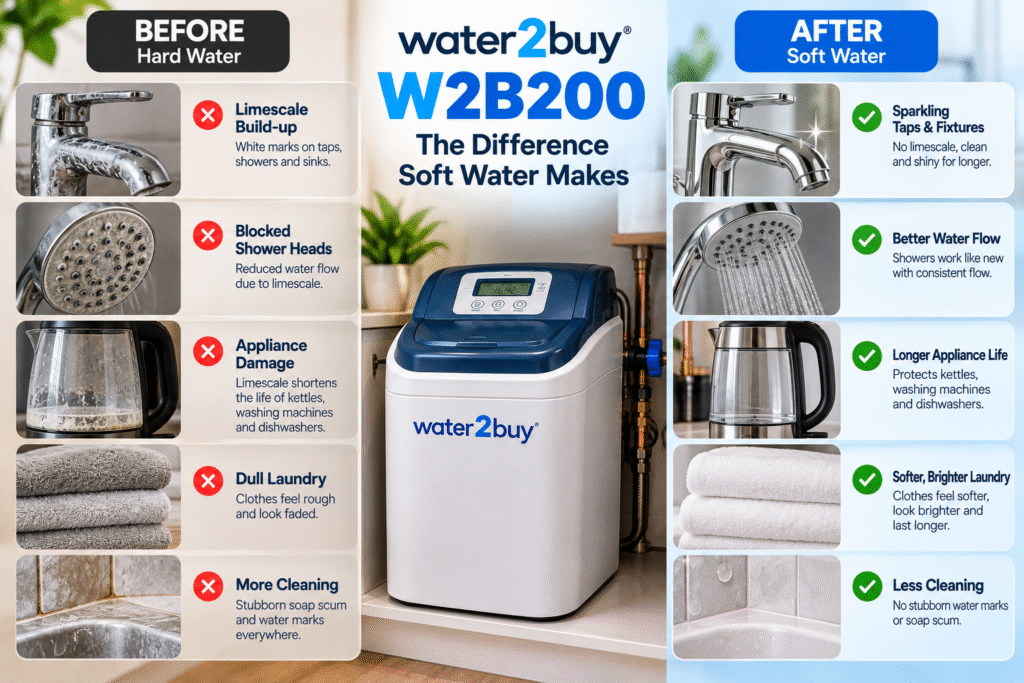
A whole-home softener like the Water2Buy W2B200 treats water as it enters the property, using ion exchange to swap the calcium and magnesium ions for sodium ions before the water reaches your taps, shower, and appliances. The practical result reported by users is a fairly quick one: less visible limescale within days to weeks, softer-feeling skin and hair, and less soap or detergent needed to get the same lathering result, since softened water requires less product to work effectively.
Signs it’s worth investigating a softener
Visible white scale build-up on kettles, taps, or shower glass within weeks of cleaning
Skin feeling tight or dry after washing, even with moisturising soap
Reduced lather from shampoo or washing-up liquid compared with visiting a soft-water area
Appliances (kettle, washing machine, dishwasher) needing descaling more than once every few months
A postcode-level hardness reading above 200ppm from your water supplier
Quick FAQ
Is hard water actually harmful to drink? No — hard water isn’t considered a health risk in the UK; the concerns are almost entirely about limescale damage to appliances and pipework, and the cosmetic/comfort effects on skin, hair and cleaning performance.
How quickly will I notice a difference after installing a softener? Many users report a visible reduction in new limescale build-up within days to a couple of weeks, since the softener treats water from the point it enters the property.
Does a softener treat my drinking water too? Yes, a whole-home unit like the W2B200 treats water throughout the property, though many households still keep a separate tap or jug filter for drinking water taste preferences.
Water2Buy W2B200 Review: Is This the Best Home Water Softener?
If you’ve searched “water2buy w2b200” trying to work out whether this budget-friendly water softener is actually worth installing, you’re probably comparing it with more expensive systems and wondering whether you really need to spend £1,000 or more.
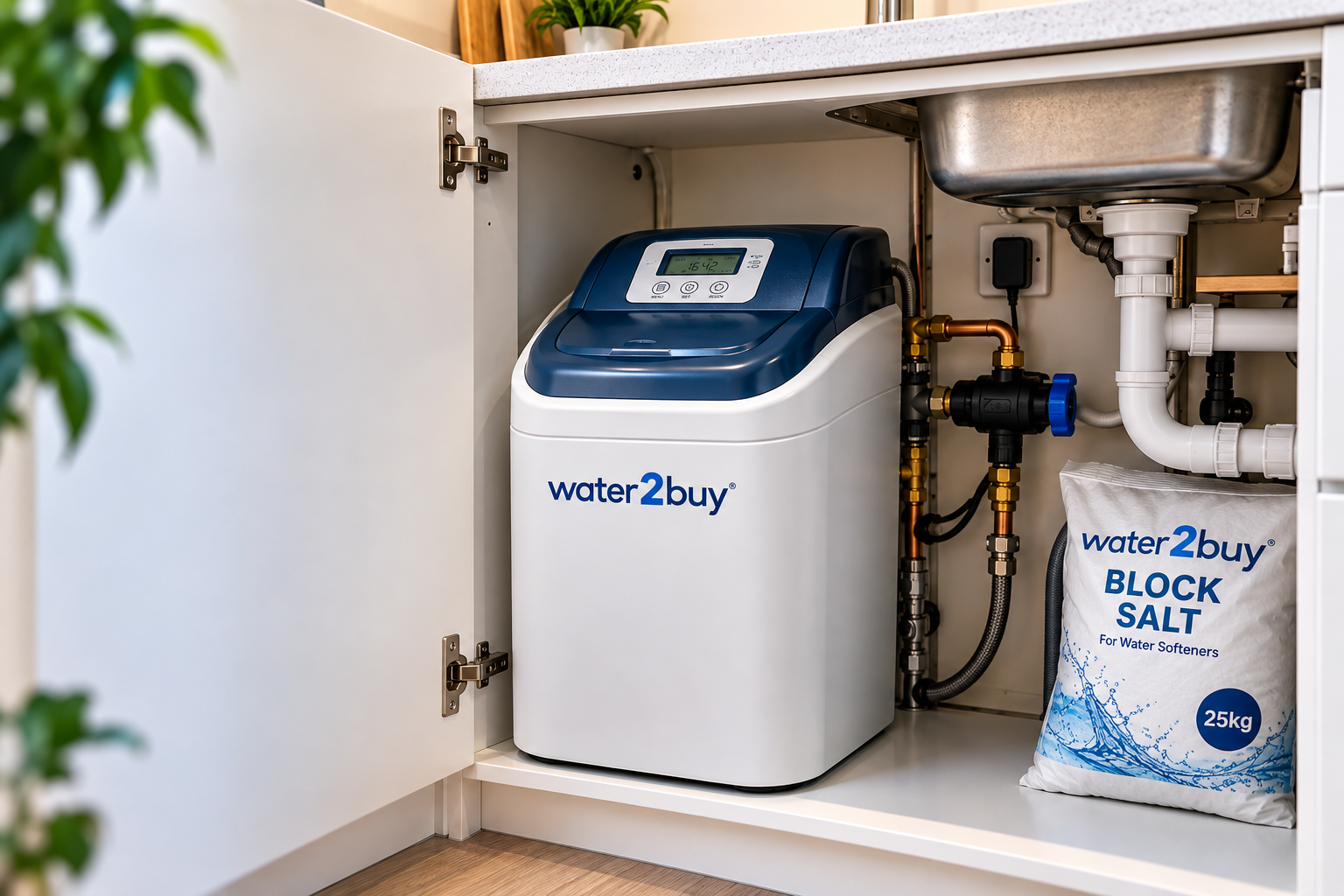
The Water2Buy W2B200 sits firmly in the more affordable end of the home water-softener market. It is designed for households of up to six people and uses a digital meter-based control system to manage regeneration according to water consumption rather than simply running on a fixed timer.
But is it actually a good buy?
Based on the manufacturer’s specifications and the themes that appear in verified buyer feedback, the W2B200 offers a compelling combination of capacity, relatively low running costs and DIY-friendly installation. However, there are a few things you should know before ordering, particularly around its physical size and the additional plumbing requirements.
The quick answer
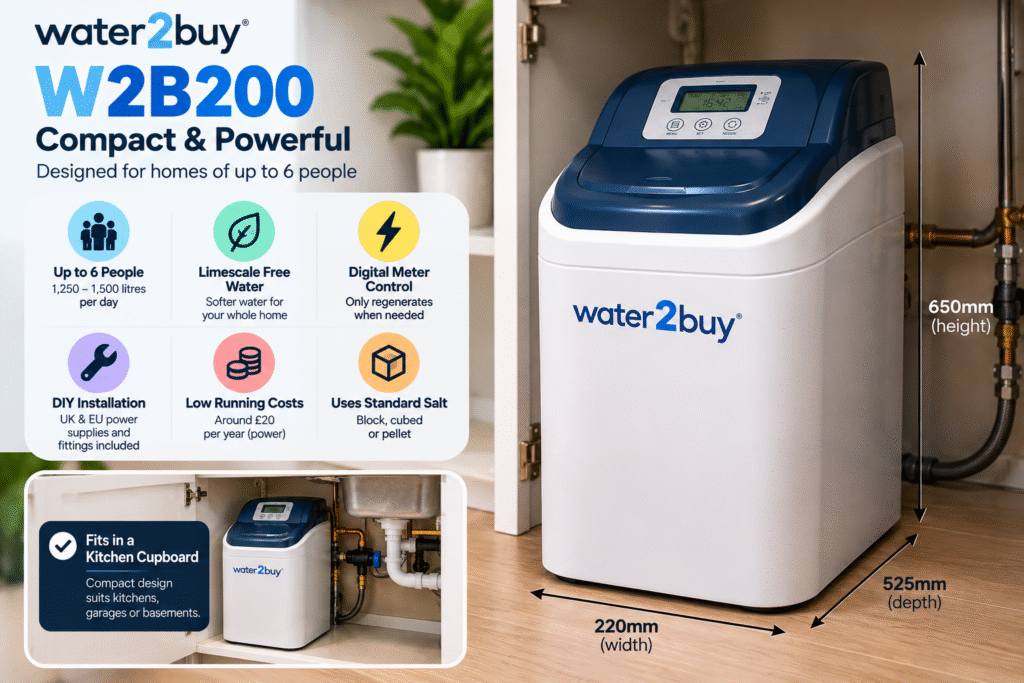
Family of up to 6? The W2B200 is designed for households of up to six people and can produce approximately 1,250–1,500 litres of softened water per day.
Budget-conscious? It typically sits around the £400–£500 price range, making it considerably cheaper than many professionally installed systems.
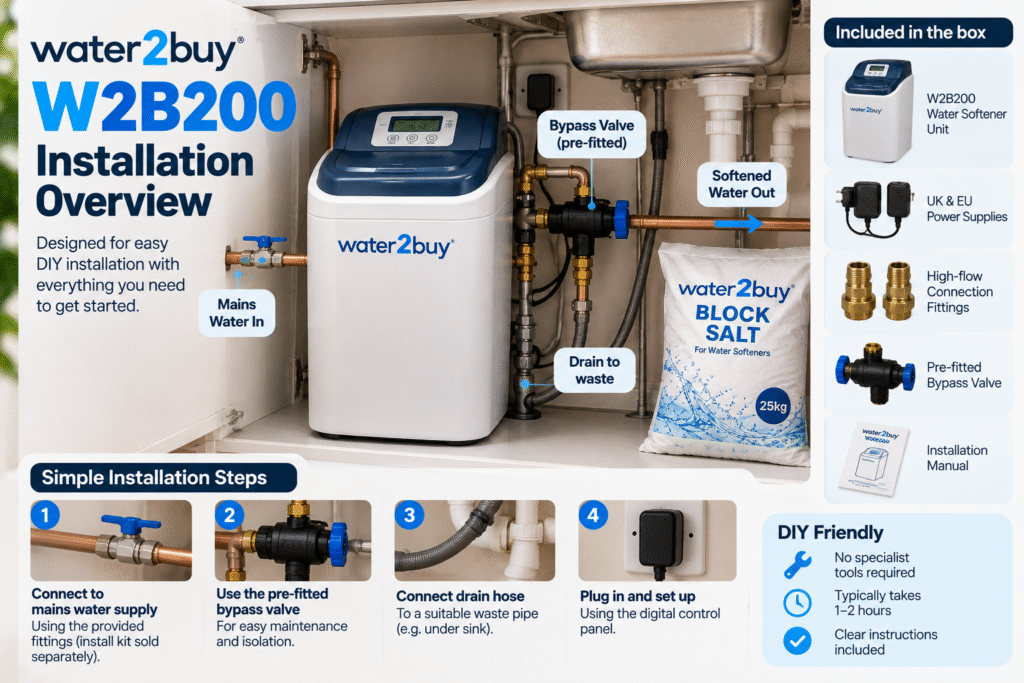
Want to DIY install? The unit is designed with self-installation in mind and comes with UK and EU power supplies, connection fittings and a pre-fitted bypass valve.
Worried about running costs? Electricity consumption is relatively low, with reported power costs of around £20 per year, although salt is an additional ongoing expense.
Short on cupboard space? This is one area where you should measure carefully. The unit is not tiny, despite being marketed as a compact home softener.
What is the Water2Buy W2B200?
The Water2Buy W2B200 is a domestic water-softening system designed to reduce the effects of hard water in your home.
Hard water contains minerals such as calcium and magnesium. Over time, these minerals can contribute to limescale deposits on taps, showerheads, sinks, kettles and other appliances that regularly come into contact with water.
A water softener works by treating the incoming water before it is distributed around your home. The aim is to reduce the hardness of the water and, consequently, reduce the amount of limescale that builds up.
The W2B200 is intended for households of up to six people and is capable of producing approximately 1,250–1,500 litres of softened water per day, depending on water hardness and usage.
It can be used with mains water supplies as well as suitable private well-water systems, making it potentially useful for a range of UK homes.
Digital meter control instead of a basic timer
One of the more interesting features of the W2B200 is its digital meter control system.
Older or simpler water softeners can operate using a timer, meaning the system regenerates according to a predetermined schedule. The problem with a fixed schedule is that your household may not always use the same amount of water.
The W2B200 instead uses water usage information to determine when regeneration is required. In principle, this means the machine does not need to regenerate unnecessarily when household consumption is lower.
That can help reduce unnecessary use of salt and water compared with older timer-controlled systems.
The digital control panel also gives you access to the system’s settings and regeneration controls. For homeowners who prefer a system they can monitor and adjust themselves, this is a useful feature.
Installation and setup
One of the biggest selling points of the W2B200 is that it is designed to be suitable for DIY installation.
The package includes the main softener, an installation manual, UK and EU power supplies, high-flow connection fittings and a pre-fitted bypass valve.
The bypass valve is particularly useful because it allows the softener to be isolated from the water supply when maintenance is required.
However, there is an important distinction between being designed for DIY installation and being completely plug-and-play.
You still need the appropriate plumbing connection to integrate the unit into your home’s mains water system. An installation kit may need to be purchased separately, depending on your setup.
If you are comfortable with basic plumbing, the installation should be manageable. If you’re not confident working with your home’s mains water supply, paying a qualified plumber may be the safer option.
How much space does the W2B200 need?
This is one of the areas where you should pay particular attention before buying.
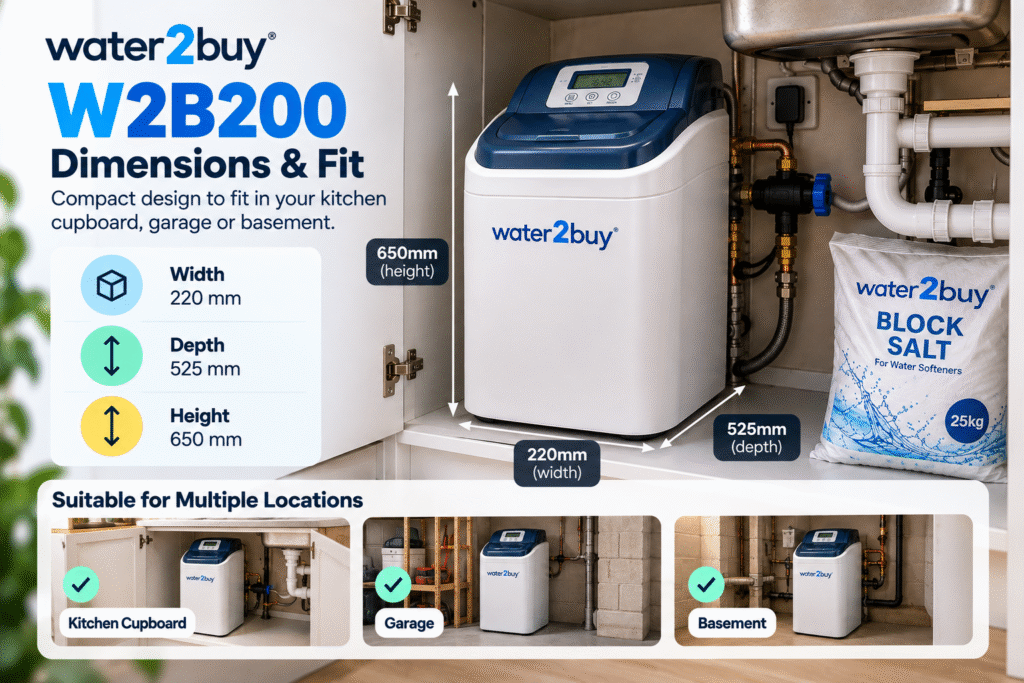
The stated dimensions are approximately:
Width: 220mm
Depth: 525mm
Height: 650mm
On paper, those dimensions make the W2B200 reasonably compact compared with some larger water-softening systems.
It can potentially be installed in a kitchen cupboard, garage, basement or another suitable utility area.
However, don’t measure your available space based purely on the dimensions of the main unit.
You’ll also need room for:
Water inlet and outlet connections
Drainage hose
Plumbing fittings
Electrical connection
Access for adding salt
Maintenance and servicing
Some buyers have found that the unit takes up more practical space than expected once the plumbing and hoses are taken into account.
Our advice: measure the cupboard or installation area carefully before ordering and leave additional clearance around the unit.
Running costs
The W2B200 is relatively inexpensive to operate from an electricity perspective.
Reported annual electricity costs are around £20 per year, although your actual cost will depend on your electricity tariff and usage.
The bigger ongoing expense is salt.
The system can use standard water-softening salt, including block, cubed or pellet varieties. How frequently you need to refill it will depend on the hardness of your local water supply and how much water your household uses.
For some households, a monthly salt refill may be typical, but this shouldn’t be treated as a fixed rule. A family of six using large amounts of water in a particularly hard-water area may use considerably more salt than a smaller household.
This means your real annual running cost will be the combination of electricity and salt rather than the electricity figure alone.
Who should buy the Water2Buy W2B200?
The W2B200 makes the most sense for homeowners who want effective water softening without spending a huge amount on a premium system.
It’s particularly worth considering if:
You live in a hard-water area.
You have a household of up to six people.
You’re experiencing regular limescale buildup.
You want to reduce deposits on taps and appliances.
You’re comfortable with basic DIY plumbing.
You want to keep the initial purchase price relatively low.
You have enough space for the unit and its plumbing.
It may be less suitable if you have extremely limited installation space or want a fully managed professional installation with minimal involvement.
Which one should you actually buy?
Replacing an old, inefficient softener?
The W2B200’s digital demand-based regeneration can be a meaningful upgrade from an older timer-based system.
Comfortable with basic DIY plumbing?
The included fittings, bypass valve and instructions make it an attractive option for confident DIY users.
Tight on cupboard space?
Measure twice before ordering. The 220 x 525 x 650mm dimensions are only part of the space calculation once hoses and connections are included.
Looking for the cheapest possible long-term option?
Don’t only compare the purchase price. Consider salt consumption, installation costs and how often the system needs maintenance when comparing different softeners.
A few things worth checking before you buy
Before clicking the buy button, check these points:
Measure your installation space precisely. Allow additional room for plumbing, drainage and maintenance access.
Check whether you need a separate installation kit. The basic unit does not necessarily provide every component required for your specific mains-water setup.
Check your local water hardness. This affects how frequently the system needs to regenerate and how much salt you may use.
Consider professional installation if you’re unsure about plumbing.
Budget for salt. Electricity is only one part of the ongoing cost.
Check the return policy and warranty before purchase, particularly if you’re installing the unit yourself.
Final verdict
So, is the Water2Buy W2B200 the best home water softener?
There isn’t one universal answer, but it is certainly a strong option for homeowners looking for a relatively affordable water softener with useful automation.
Its biggest strengths are its household capacity, digital meter control, DIY-friendly design and relatively low electricity consumption. At a typical price of around £400–£500, it also offers a much lower entry price than many professionally installed alternatives.
The main things to watch are installation space, plumbing requirements and ongoing salt costs.
For a household of up to six people that wants to tackle hard-water problems without spending £1,000+ on a premium system, the Water2Buy W2B200 is worth considering.
Just measure your installation area carefully, understand the additional plumbing requirements and calculate the ongoing salt cost before making your final decision.
Quick FAQ
How many people can the Water2Buy W2B200 support?
The W2B200 is designed for households of up to six people and can produce approximately 1,250–1,500 litres of softened water per day, depending on water hardness and usage.
Can I install the W2B200 myself?
Yes. The system is designed with DIY installation in mind and includes connection fittings, a bypass valve, power supplies and an installation manual. However, you’ll still need to connect it correctly to your home’s water supply and drainage.
How much does the W2B200 cost to run?
Electricity consumption is relatively low, with reported power costs of around £20 per year. You will also need to factor in the ongoing cost of water-softening salt.
How often does the salt need replacing?
There is no universal replacement interval. A monthly refill may be typical for some households, but actual consumption depends on household water usage and local water hardness.
Will it fit under my kitchen sink?
It may fit in a suitable kitchen cupboard, but you should check the full dimensions of 220 x 525 x 650mm and allow additional space for pipes, hoses, drainage and maintenance access.
Is the Water2Buy W2B200 worth buying?
For homeowners looking for an affordable, relatively simple water-softening solution for a household of up to six people, it can be a good option. Its value is strongest when you are comfortable with DIY installation and have enough space for the unit.nding on usage.
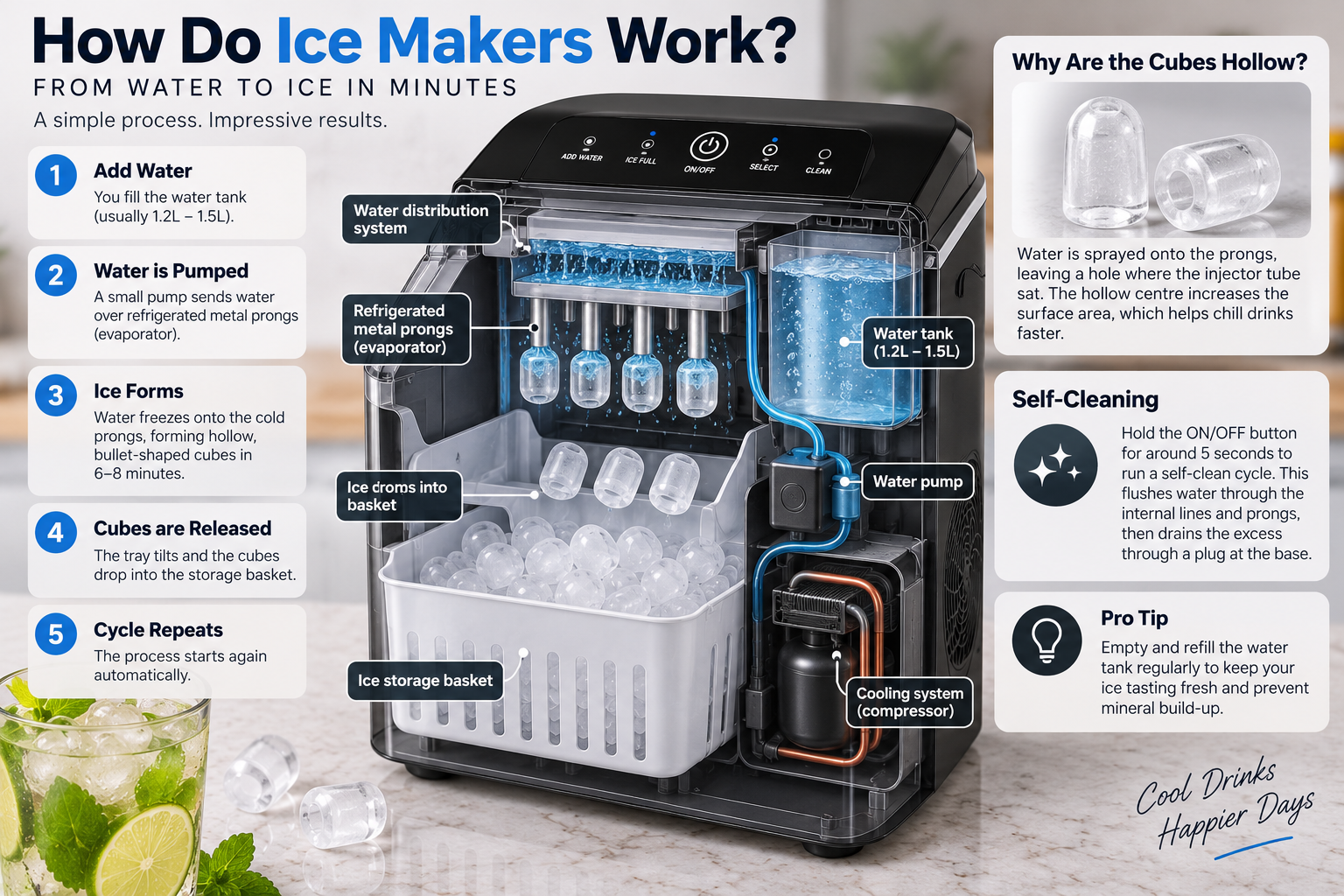
Basic mechanism: water is pumped over refrigerated metal prongs, which freeze it into bullet-shaped cubes in minutes rather than hours.
Cleaning: most countertop machines, including the PALINTH, have a self-clean cycle triggered by holding the power button for several seconds.
Most common problem: stale-tasting ice, almost always caused by leaving unused meltwater sitting in the recycling tank too long.
The basic mechanism
Unlike a freezer, which chills an entire compartment slowly over hours, a countertop ice maker uses a small refrigerated set of metal prongs (an evaporator) that water is pumped over continuously. As water flows over the cold prongs it freezes in place, forming the hollow bullet-shaped cubes typical of this category. Once a cycle finishes, the machine tips or releases the tray so the cubes drop into the storage basket, and the cycle repeats — which is how a batch of 9 cubes can be ready in 6–8 minutes rather than the hours a freezer tray takes.
Why the cubes are hollow
The bullet shape isn’t just cosmetic, it’s a side effect of how the water is sprayed onto the prongs, leaving a hole where the injector tube sat. That hollow centre actually increases the ice’s surface area, which is why bullet ice melts a little faster than a solid cube from a freezer tray, and why makers recommend using it soon after it’s made rather than banking a large reserve.
Self-cleaning: what it actually does
Most modern countertop ice makers, PALINTH included, trigger a self-cleaning cycle by holding the ON/OFF button for around five seconds. This runs water through the internal lines and prongs to flush out mineral build-up and any residue, finishing by draining the excess through a plug in the base. Doing this every few weeks — more often in hard water areas — keeps the ice tasting clean and prevents scale building up on the evaporator prongs.
The most common complaint: stale-tasting ice
By far the most frequent real-world issue reported by owners isn’t a fault — it’s how these machines are designed to work. When ice isn’t removed and used, most countertop makers recycle the meltwater back into the internal tank rather than keeping cubes frozen solid, since there’s no separate freezer compartment. Left for a day or two, that recycled water can pick up a stale taste. The fix is simple: empty the machine and refill with fresh water if you’re not using it daily, rather than leaving it topped up and idle.
Other common problems and fixes
Machine shows “ice full” but the basket looks empty: usually a sensor misread caused by water sitting where the ice should be — empty the basket fully and let a fresh cycle run.
Ice takes far longer than 6–8 minutes: check the water level first, since running low triggers a slower or interrupted cycle; also make sure the unit isn’t in direct sun or too close to a heat source.
Cubes are smaller or misshapen: worth checking the size selector wasn’t accidentally left on a mismatched setting, and that the water tank is topped up to the recommended line.
Lid won’t stay open during loading: a minor but common gripe on budget models — most have a simple prop mechanism that needs to click into a stop rather than being left to rest freely.
Maintenance checklist
Run the self-clean cycle every 2–4 weeks (more often in hard water areas)
Empty and refresh the water tank if the machine goes unused for more than a day
Wipe the ice basket and transparent lid to prevent residue build-up
Keep the unit away from direct sunlight and heat sources for consistent cycle times
Use fresh, cold water for each fill rather than topping up stale water
Quick FAQ
Why does my ice maker’s ice taste odd after a day or two? Nearly always because the machine recycles unused meltwater rather than keeping cubes frozen. Empty and refill regularly if you’re not using it daily.
How often should I run the self-cleaning cycle? Every 2–4 weeks under normal use, and more frequently if you’re in a hard water area, since mineral scale builds up faster on the evaporator prongs.
Why are the ice cubes hollow in the middle? It’s a result of how water is sprayed onto the freezing prongs during the bullet-ice process, not a fault — the hollow centre is standard for this type of machine.