
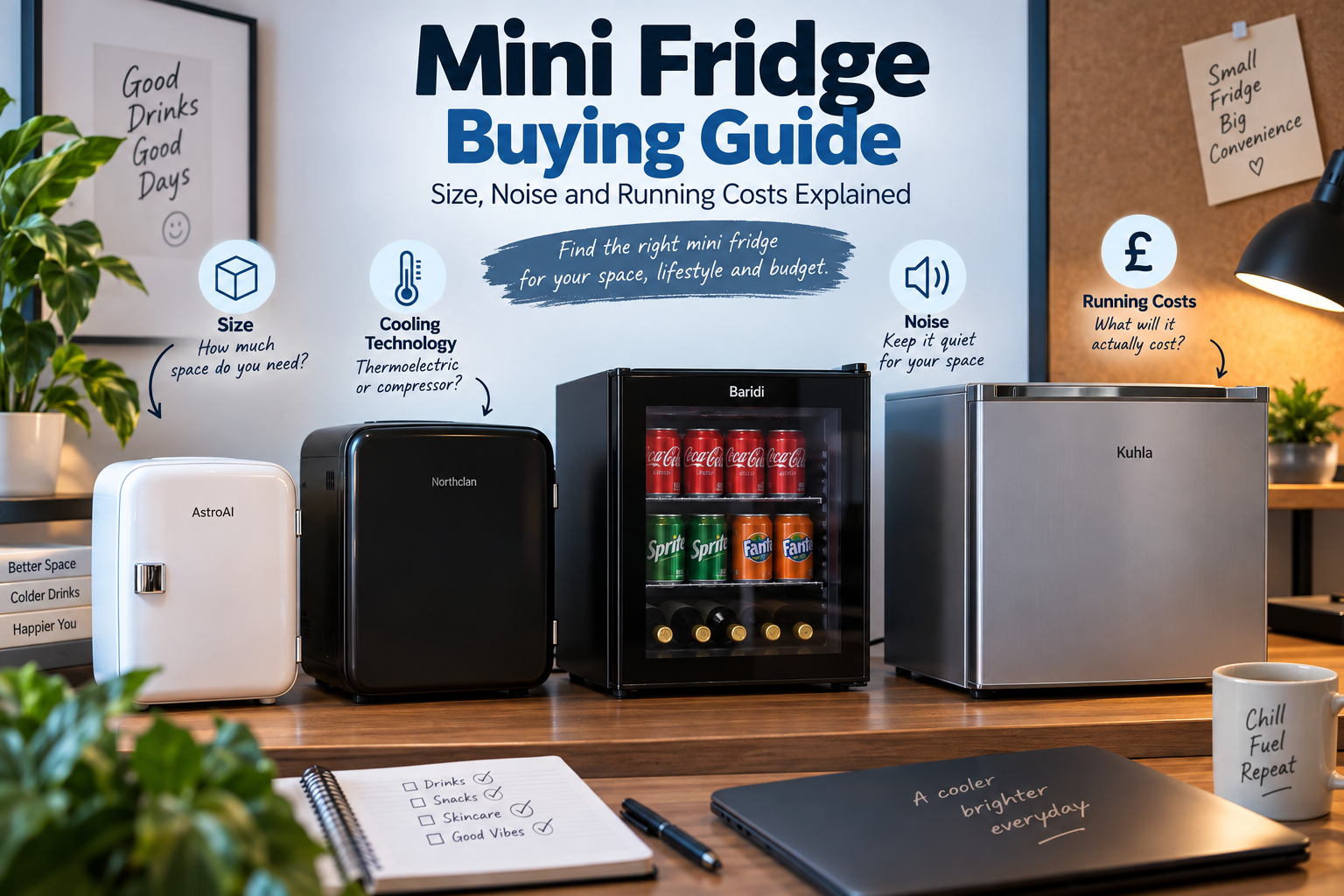
Mini Fridge Buying Guide: Size, Noise and Running Costs Explained
Mini fridges look simple, but the market is more varied than it first appears — and the wrong pick for your use case is an easy, avoidable mistake. This guide walks through what genuinely matters: capacity, cooling technology, noise, and what it actually costs to run in the UK right now.
The quick answer
- Just want drinks and skincare cold, quietly, on a budget? A thermoelectric fridge like AstroAI or Northclan is enough.
- Need it to hold a proper cold temperature regardless of room heat? Look for compressor cooling, like Baridi’s 35L drinks cooler.
- Want the biggest drinks capacity for a table-top footprint? The Kuhla 45L holds the most of any fridge in this guide.
Affiliate link placeholder: [insert your Amazon Associates tracking link here]
Step 1: work out the capacity you actually need
- 6–9L (AstroAI-style): up to 8 cans or 4 water bottles (Amazon UK, AstroAI Mini Fridge 6L). Desk or bedside use only.
- 15–21L (Northclan-style): around 21 cans (Amazon UK, Northclan 15L Mini Fridge), or a mix of drinks, snacks and cosmetics. A reasonable all-rounder for a bedroom.
- 35–45L (Baridi, Kuhla-style): the 35L Baridi holds wine bottles, beer cans, soft drinks and snacks (Amazon UK, Baridi 35L Drinks Cooler DH58), while the Kuhla 45L fits up to 42 cans — the range to look at for a home bar or genuine secondary fridge.
Step 2: understand the two cooling technologies
This is the spec most buyers skip past, and it explains most of the confusing reviews online.
Thermoelectric cooling (AstroAI, Northclan, Kuhla) uses an electronic plate rather than a compressor. It’s quiet and light, but it only cools a fixed number of degrees below whatever temperature the room already is — AstroAI’s own spec confirms this, stating the fridge typically lowers temperatures by 18–22°C below ambient (AstroAI UK, Mini Fridges range page) rather than hitting a fixed target. On a warm day, that might mean 15°C rather than a proper cold 4–5°C — fine for drinks and cosmetics, not reliable for perishable food.
Compressor cooling (Baridi’s range) works the same way as a full-size kitchen fridge, so it hits and holds a genuine target temperature regardless of room heat. Baridi’s 35L drinks cooler, for example, uses compressor cooling with an automatic defrost feature rather than a thermoelectric chip (Amazon UK, Baridi 35L Drinks Cooler DH58). It costs more and weighs more, but it’s the only real option here if food safety matters, not just chilled drinks.
Step 3: check the noise rating
Noise matters more for a bedroom fridge than a kitchen one. Two real reference points from this guide’s products:
- Near-silent: Baridi’s 35L model is rated at 25dB, described as suitable for bedrooms, hotel rooms and offices (Amazon UK, Baridi 35L Drinks Cooler DH58).
- Quiet, documented: Northclan’s ECO mode is rated at 28dB (Amazon UK, Northclan 15L Mini Fridge).
If a listing doesn’t give a dB figure at all, treat that as a small red flag — brands that have tested for quiet running are usually keen to state it.
Step 4: work out the running cost
Manufacturers list annual energy consumption in kWh on the label. Multiply that by the current electricity unit rate for a rough yearly cost. Under the Ofgem price cap for the current quarter (1 July–30 September 2026), UK households on a standard variable Direct Debit tariff pay an average of 26.11 pence per kilowatt hour (Ofgem, energy price cap unit rates).
Using real figures from this guide:
- Northclan 15L: ~94 kWh/year (Amazon UK listing) → roughly £24.50/year
- Baridi 35L drinks cooler: 140 kWh/year (Amazon UK listing) → roughly £36.50/year
Compact mini fridges are a fraction of a full-size fridge-freezer’s running cost — one of the genuine advantages of going small. (Ofgem reviews the price cap quarterly, so check the current Ofgem rate before relying on this for budgeting further out.)
Step 5: placement and maintenance
- Ventilation: most mini fridges need a small gap behind and above for heat to escape — pushing one flush against a wall can reduce efficiency and raise noise.
- Defrosting: thermoelectric models rarely need manual defrosting; compressor units like Baridi’s benefit from their automatic defrost feature.
- Door reversibility: genuinely useful in a tight layout, not just a spec-sheet extra.
The checklist
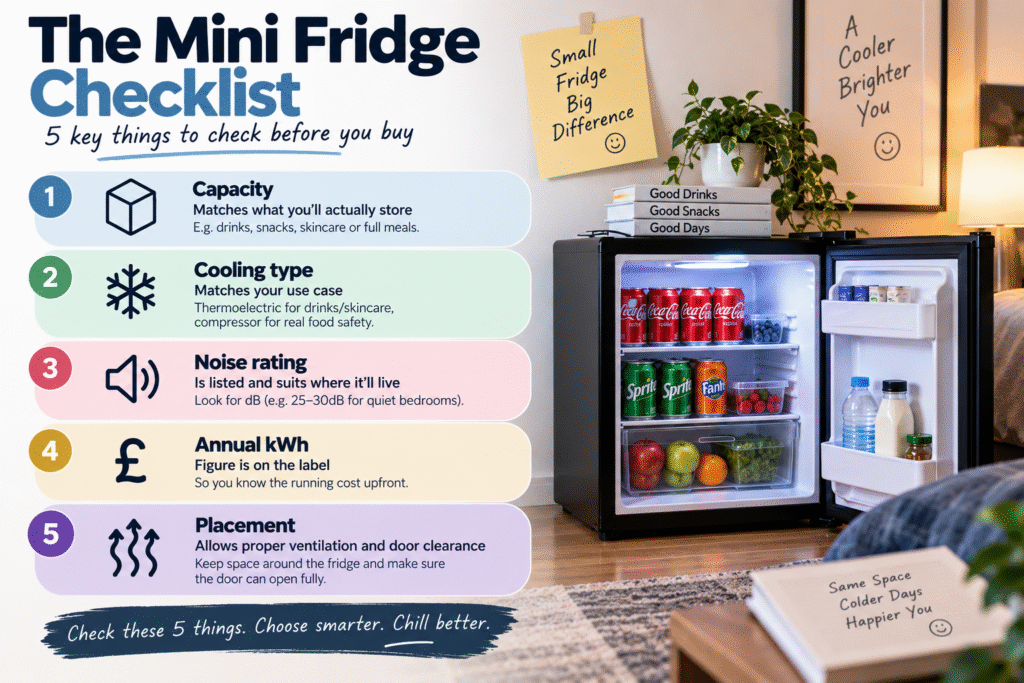
- Capacity matches what you’ll actually store
- Cooling type matches your use case — thermoelectric for drinks/skincare, compressor for real food safety
- Noise rating is listed and suits where it’ll live
- Annual kWh figure is on the label, so you know the running cost upfront
- Placement allows proper ventilation and door clearance
Quick FAQ
Is thermoelectric or compressor cooling better for a mini fridge? Neither is universally “better” — thermoelectric (AstroAI, Northclan, Kuhla) is quieter and cheaper but only cools relative to room temperature; compressor cooling (Baridi) holds a genuine target temperature with automatic defrost, better suited to anything perishable.
How much does it cost to run a mini fridge in the UK? Based on the current Ofgem rate of 26.11p per kWh, a fridge using around 94–140 kWh a year costs roughly £24–£37 annually — a small fraction of a full-size fridge-freezer.
What’s a good noise level for a bedroom mini fridge? Anything at or below 28dB is genuinely quiet for a bedroom — both the Baridi 35L (25dB) and Northclan 15L (28dB in ECO mode) hit that bar with documented figures.