
Food Processor vs Blender: Which Is Better for Your Kitchen?
At first glance, a food processor and blender seem to do the same job: put food into the jug, press a button and hope something tasty comes out.
Unfortunately, buying the wrong one is an excellent way to discover that this isn’t quite the case.
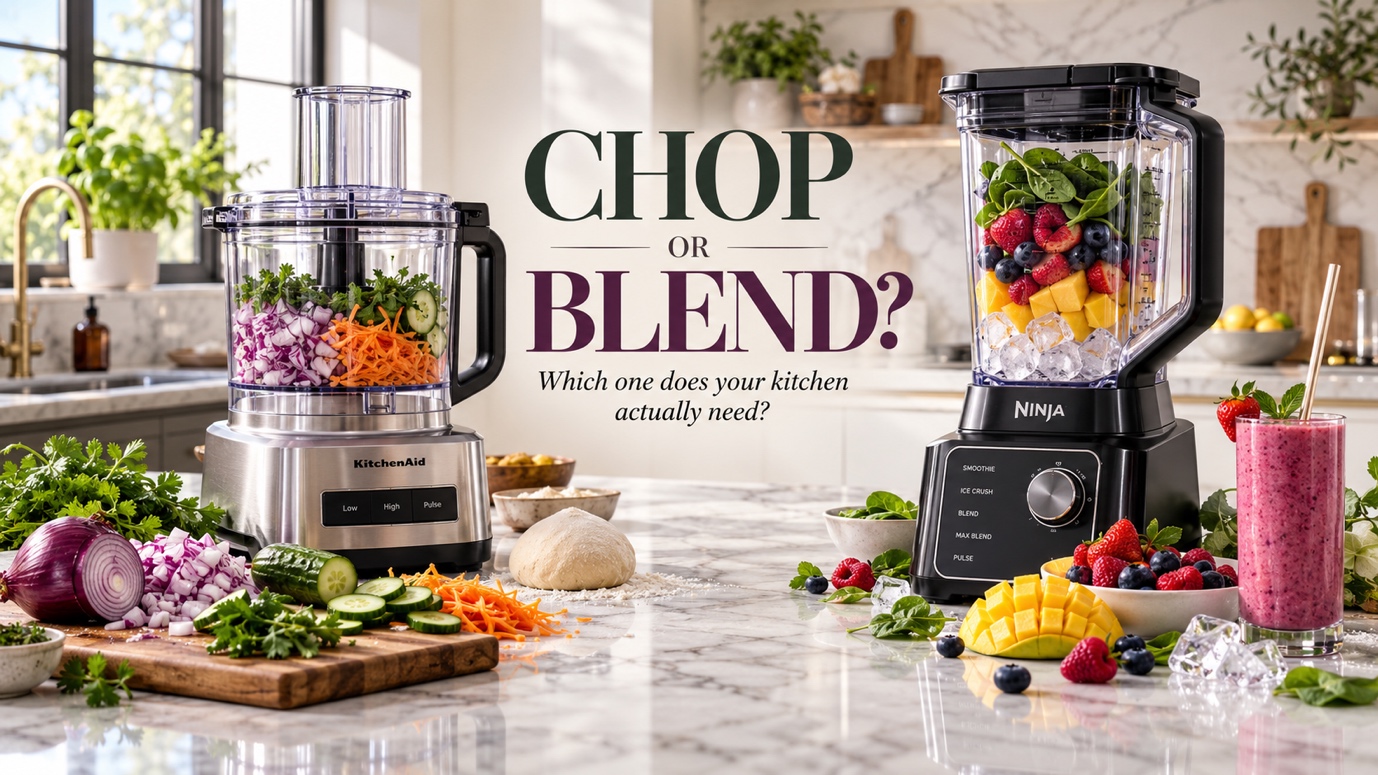
In the food processor vs blender debate, the simple answer is this: a blender is better for liquids and smooth mixtures, while a food processor is better for chopping, slicing, grating and preparing solid ingredients.
If smoothies are your priority, buy a blender. If you want help preparing dinner, a food processor probably makes more sense.
The quick answer
Choose a food processor if: you regularly chop vegetables, grate cheese, slice ingredients, make dough or prepare dips and mixtures.
Choose a blender if: smoothies, shakes, sauces and liquid recipes are your main go-to.
Biggest food processor advantage: versatility with solid ingredients.
Biggest blender advantage: smoother results with liquids and frozen ingredients.
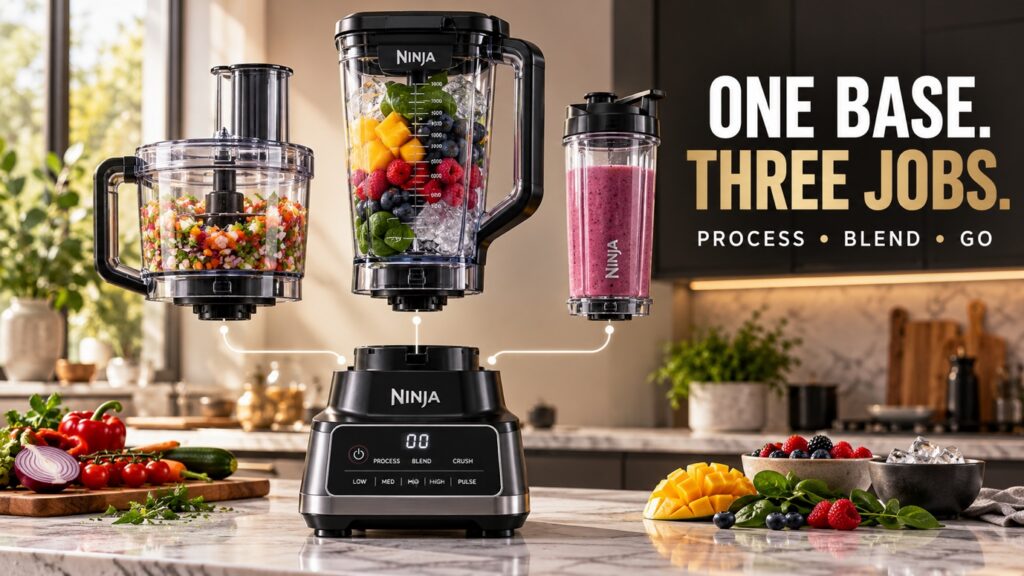
Need both? Combination appliances such as the Ninja 3-in-1 Food Processor with Auto-iQ can provide a processing bowl, full-size blender and personal blending cup from one motor base
| Food processor | Blender | |
| Best for | Food preparation | Drinks and liquids |
| Chopping | Excellent | Limited |
| Slicing/grating | Excellent | No |
| Smoothies | Possible on some models | Excellent |
| Dough | Often yes | Generally no |
| Frozen fruit/ice | Model dependent | Usually better |
| Liquid capacity | Less important | Major strength |
| Main advantage | Versatility | Smooth blending |
What does a food processor do?
Think of a food processor as an assistant for all the tedious prep that happens before you start cooking.
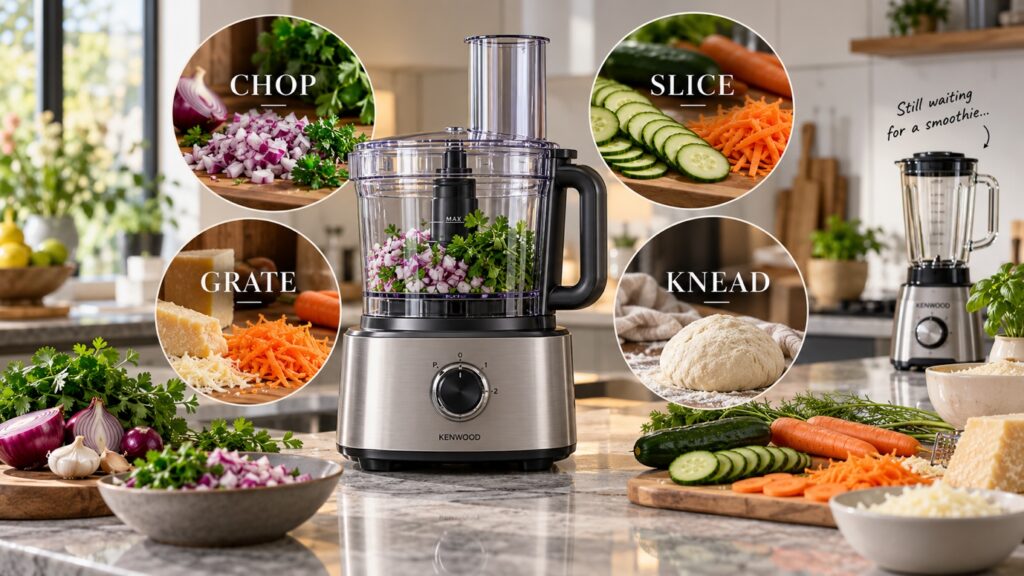
It’ll chop onion, grate carrots, and slice cucumber without breaking a sweat.
Depending on the attachments included, a food processor can also knead dough, whisk ingredients, puree vegetables, shred cheese and mix everything from burger mixtures to dips.
The wide bowl is important here. Ingredients have room to move around, while interchangeable blades and discs allow the machine to perform completely different jobs.
That’s why asking “what does a food processor do?” has a pretty vague answer:
Quite a lot.
Our recent Kenwood MultiPro Compact review is a good example. Its processor can chop, slice, grate, knead and whisk, while still remaining compact enough for a smaller kitchen.
Where a blender wins
A blender is much more specialised.
Instead of offering five different discs and attachments that look like they belong in a toolbox, it usually gives you one tall jug and a powerful set of blades.
That design is brilliant when there’s plenty of liquid involved.
Smoothies are the obvious example. Fruit, milk, yoghurt, protein powder and ice can circulate around the jug and repeatedly pass through the blades until the mixture becomes smooth.
Blenders are also useful for sauces, dips, dressings and other liquid-heavy mixtures.
Where they struggle, is when you start asking them to perform food-preparation jobs they weren’t designed for.
Can a powerful blender destroy an onion?
Absolutely.
Can it neatly slice that onion into even pieces?
Well, it depends on what you define as “even pieces “.
Chopping vs blending is the real difference
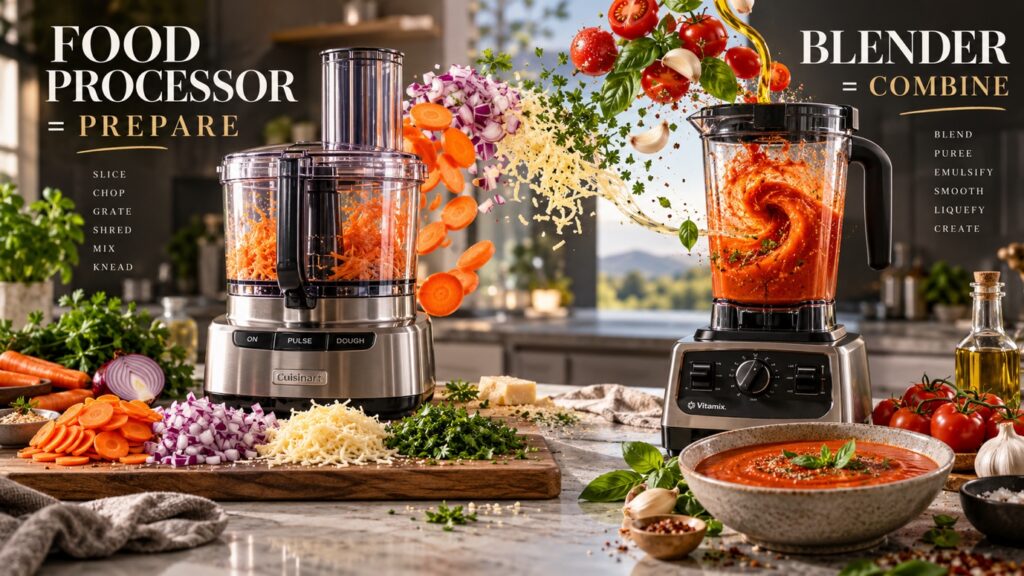
This is probably the easiest way to understand the food processor vs blender question.
A food processor is designed to prepare ingredients.
A blender is designed to combine them.
Put carrots through the slicing disc of a food processor and you can get fairly consistent slices.
Put those same carrots into a powerful blender and you’re left with carrot puree.
Neither result is wrong, they’re just intended for different meals.
The same applies to texture. If you’re making salsa and want lumps of tomato, onion and pepper, a processor gives you much more control.
If you’re making a completely smooth tomato sauce, the blender suddenly becomes the more useful machine.
Which is better for smoothies?
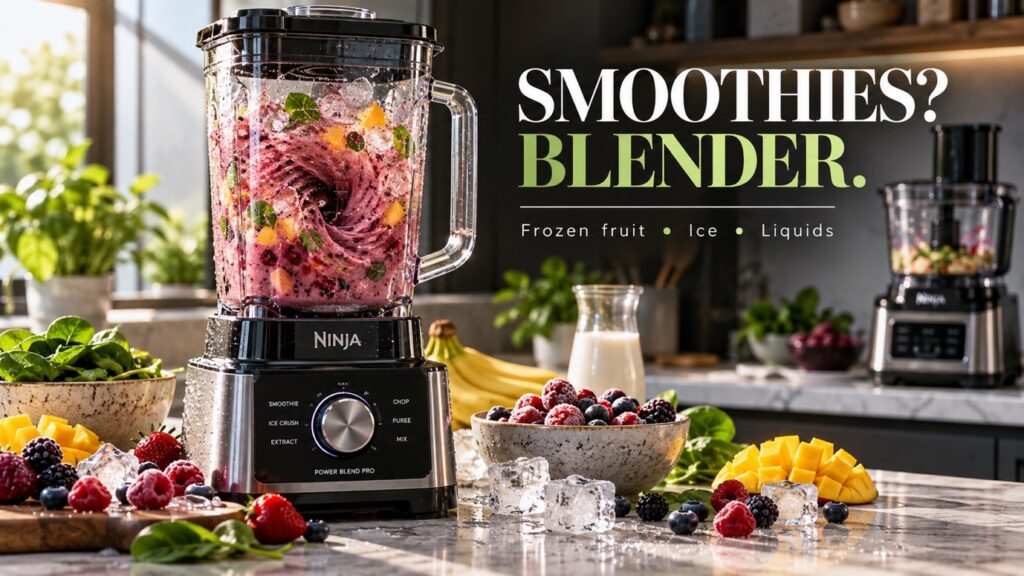
Blender.
This one isn’t even close.
A proper blender is designed for exactly the type of ingredients used in smoothies: liquid, fruit, frozen ingredients and ice.
Food processors can puree fruit, and some machines include separate blender attachments, but the processing bowl itself isn’t usually the most best place to make your morning drink.
If smoothies are a major reason you’re buying an appliance, read our Personal Blender vs Jug Blender guide before deciding which type of blender makes sense.
And once you’ve bought one, our 10 Easy Smoothie Recipes You Can Make in 5 Minutes article gives you something a little more interesting to shake up your morning smoothie routine.
Which is better for cooking?
This time, food processor.
For everyday meal preparation, it’s far more flexible.
Take some nice homemade burgers, with coleslaw and bread rolls.
The processor can chop onions and herbs for the burgers, grate carrots and cabbage for the coleslaw, then use a dough attachment for the rolls.
A standard blender, on the other hand, will turn your carrots, cabbage and onions into a bowl of liquid salad.
That’s why households that often cook from scratch may get more use out of a processor.
What if you want both?
This is where a combination appliance enters the building.
The Ninja 3-in-1 Food Processor with Auto-iQ BN800UK uses one 1200W motor base with a 1.8L food processor bowl, 2.1L blending jug and 700ml single-serve cup. The processor setup can chop, slice, grate, mix and work with dough, while the blender attachments cover larger batches and individual drinks.
In other words, you don’t really have to choose.
The downside is that you’ll still have several bowls, blades and attachments to store, but a combined appliance saves you from owning multiple motor bases.
For kitchens where worktop space matters, though, that’s still potentially useful.
Check the latest Ninja 3-in-1 Food Processor & Blender price on Amazon UK.
Blender or food processor: which do you need?
Choose a food processor if:
- You cook from scratch regularly.
- Chopping, slicing and grating take up too much time.
- You make dough, dips or mixtures.
- Smoothies aren’t your main priority.
- You want one appliance to handle several preparation jobs.
Choose a blender if:
- You mainly make smoothies or shakes.
- You frequently use frozen fruit or ice.
- Sauces and liquid mixtures are more important than chopping.
- You want fewer attachments.
- You don’t need slicing or grating functions.
The verdict
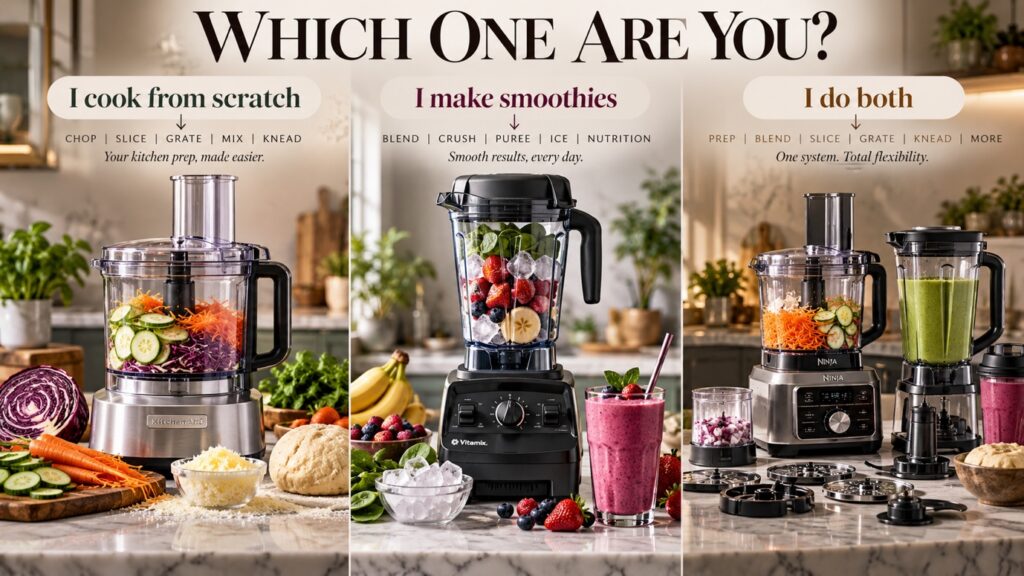
There isn’t really a winner in the food processor vs blender debate because the two appliances solve different problems.
A blender is the better choice for smoothies, drinks and smooth liquid recipes. A food processor is considerably more useful for chopping, slicing, grating, mixing and general food preparation.
If you’re still stuck between a blender or food processor, think about what annoys you most in the kitchen.
If it’s spending ten minutes chopping vegetables, buy the processor.
If it’s finding lumps of frozen strawberry floating around your smoothie, buy the blender.
And if both sound familiar, a combined machine such as the Ninja 3-in-1 may be the more sensible route.
Best for food preparation: Food processor
Best for smoothies and liquids: Blender
Best for maximum versatility: Combined processor/blender system
Related guides
- Kenwood MultiPro Compact Review: Is It the Best Small Food Processor?
- Personal Blender vs Jug Blender: Which Should You Buy for Smoothies?
- 10 Easy Smoothie Recipes You Can Make in 5 Minutes
Want both functions in one base? Check the latest Ninja 3-in-1 Food Processor & Blender price and availability on Amazon UK.