
Water2Buy W2B200 Review: Is This the Best Home Water Softener?
Water2Buy W2B200 Review: Is This the Best Home Water Softener?
If you’ve searched “water2buy w2b200” trying to work out whether this budget-friendly water softener is actually worth installing, you’re probably comparing it with more expensive systems and wondering whether you really need to spend £1,000 or more.
The Water2Buy W2B200 sits firmly in the more affordable end of the home water-softener market. It is designed for households of up to six people and uses a digital meter-based control system to manage regeneration according to water consumption rather than simply running on a fixed timer.
But is it actually a good buy?
Based on the manufacturer’s specifications and the themes that appear in verified buyer feedback, the W2B200 offers a compelling combination of capacity, relatively low running costs and DIY-friendly installation. However, there are a few things you should know before ordering, particularly around its physical size and the additional plumbing requirements.
The quick answer
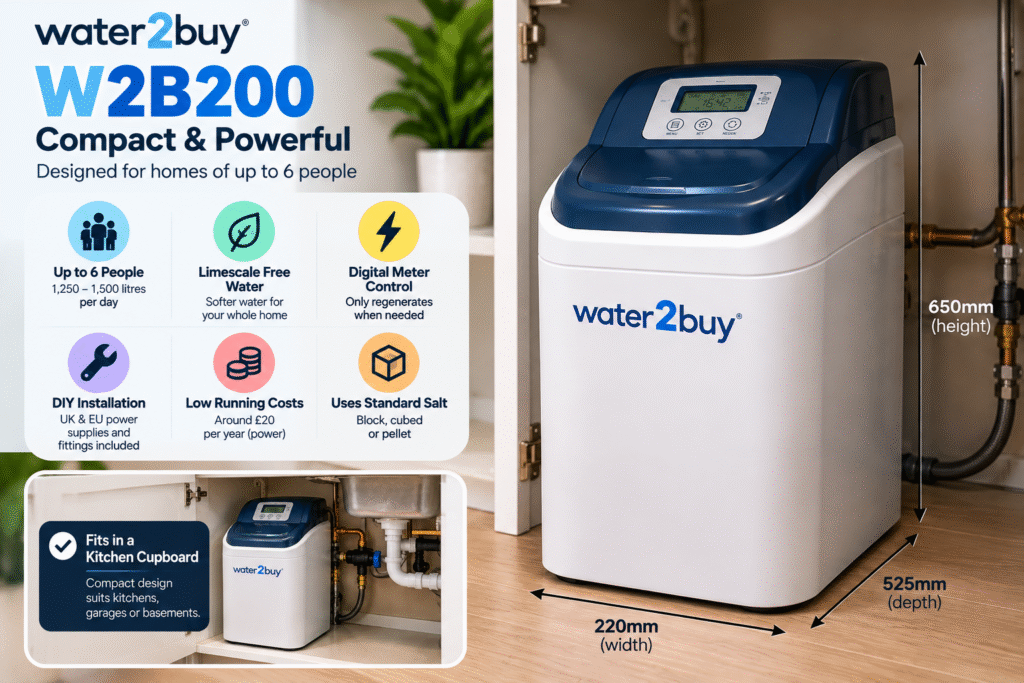
- Family of up to 6? The W2B200 is designed for households of up to six people and can produce approximately 1,250–1,500 litres of softened water per day.
- Budget-conscious? It typically sits around the £400–£500 price range, making it considerably cheaper than many professionally installed systems.
- Want to DIY install? The unit is designed with self-installation in mind and comes with UK and EU power supplies, connection fittings and a pre-fitted bypass valve.
- Worried about running costs? Electricity consumption is relatively low, with reported power costs of around £20 per year, although salt is an additional ongoing expense.
- Short on cupboard space? This is one area where you should measure carefully. The unit is not tiny, despite being marketed as a compact home softener.
What is the Water2Buy W2B200?
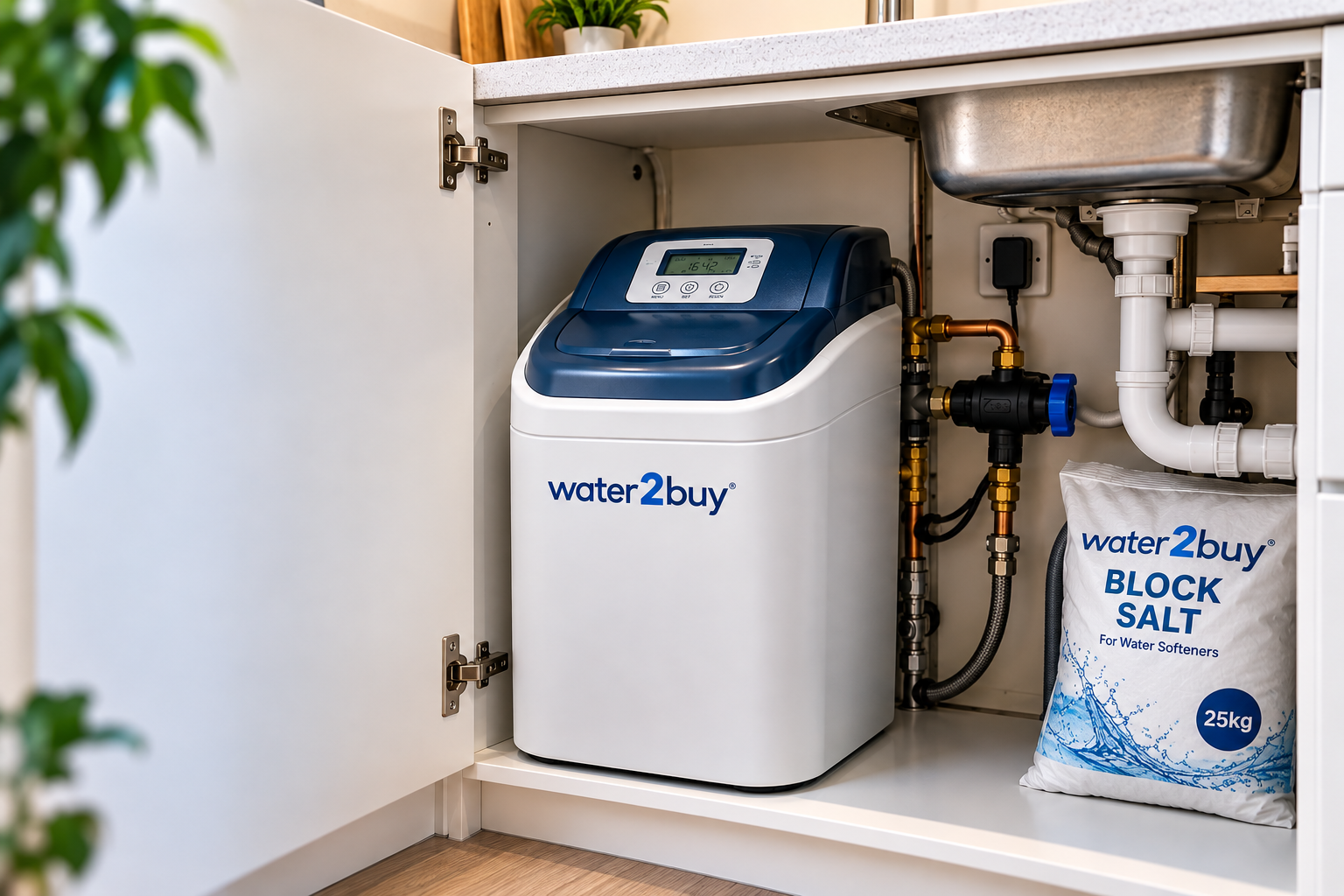
The Water2Buy W2B200 is a domestic water-softening system designed to reduce the effects of hard water in your home.
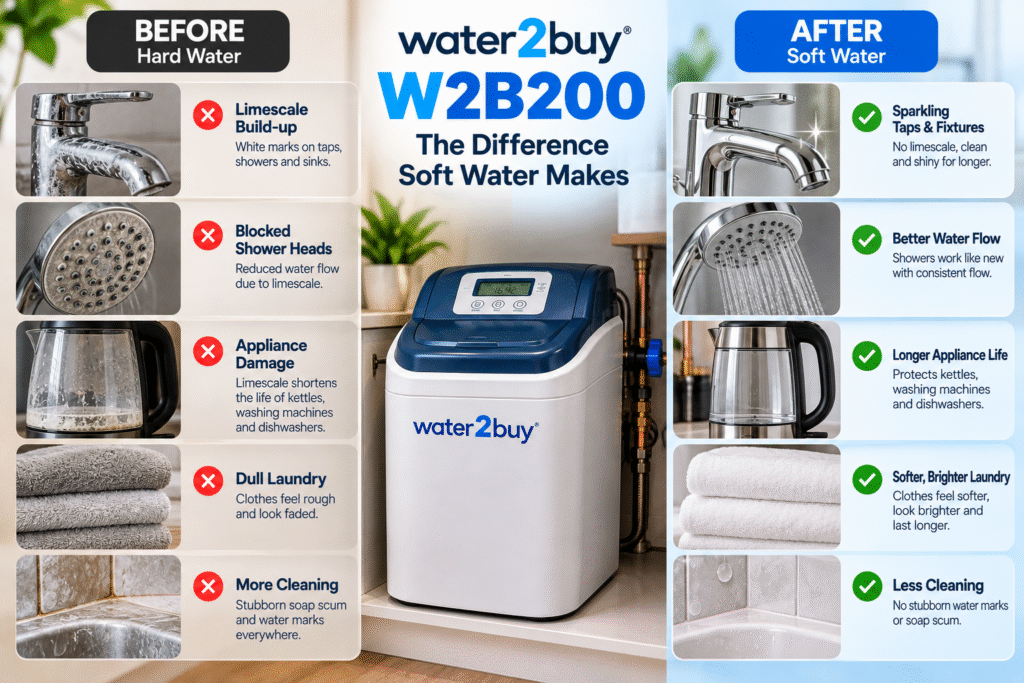
Hard water contains minerals such as calcium and magnesium. Over time, these minerals can contribute to limescale deposits on taps, showerheads, sinks, kettles and other appliances that regularly come into contact with water.
A water softener works by treating the incoming water before it is distributed around your home. The aim is to reduce the hardness of the water and, consequently, reduce the amount of limescale that builds up.
The W2B200 is intended for households of up to six people and is capable of producing approximately 1,250–1,500 litres of softened water per day, depending on water hardness and usage.
It can be used with mains water supplies as well as suitable private well-water systems, making it potentially useful for a range of UK homes.
Digital meter control instead of a basic timer
One of the more interesting features of the W2B200 is its digital meter control system.
Older or simpler water softeners can operate using a timer, meaning the system regenerates according to a predetermined schedule. The problem with a fixed schedule is that your household may not always use the same amount of water.
The W2B200 instead uses water usage information to determine when regeneration is required. In principle, this means the machine does not need to regenerate unnecessarily when household consumption is lower.
That can help reduce unnecessary use of salt and water compared with older timer-controlled systems.
The digital control panel also gives you access to the system’s settings and regeneration controls. For homeowners who prefer a system they can monitor and adjust themselves, this is a useful feature.
Installation and setup
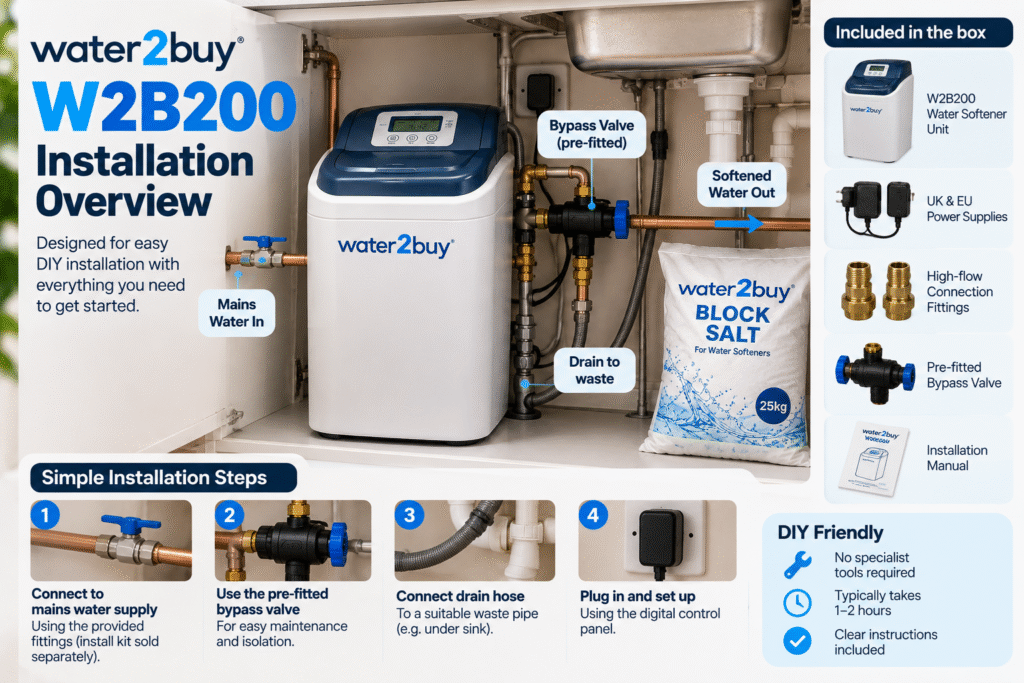
One of the biggest selling points of the W2B200 is that it is designed to be suitable for DIY installation.
The package includes the main softener, an installation manual, UK and EU power supplies, high-flow connection fittings and a pre-fitted bypass valve.
The bypass valve is particularly useful because it allows the softener to be isolated from the water supply when maintenance is required.
However, there is an important distinction between being designed for DIY installation and being completely plug-and-play.
You still need the appropriate plumbing connection to integrate the unit into your home’s mains water system. An installation kit may need to be purchased separately, depending on your setup.
If you are comfortable with basic plumbing, the installation should be manageable. If you’re not confident working with your home’s mains water supply, paying a qualified plumber may be the safer option.
How much space does the W2B200 need?
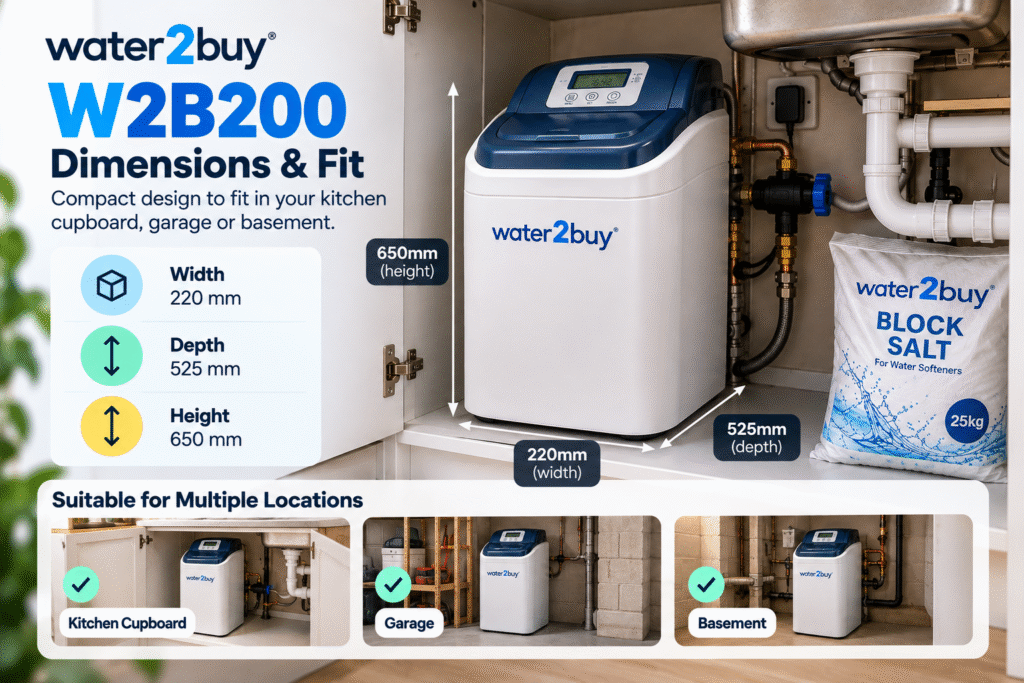
This is one of the areas where you should pay particular attention before buying.
The stated dimensions are approximately:
- Width: 220mm
- Depth: 525mm
- Height: 650mm
On paper, those dimensions make the W2B200 reasonably compact compared with some larger water-softening systems.
It can potentially be installed in a kitchen cupboard, garage, basement or another suitable utility area.
However, don’t measure your available space based purely on the dimensions of the main unit.
You’ll also need room for:
- Water inlet and outlet connections
- Drainage hose
- Plumbing fittings
- Electrical connection
- Access for adding salt
- Maintenance and servicing
Some buyers have found that the unit takes up more practical space than expected once the plumbing and hoses are taken into account.
Our advice: measure the cupboard or installation area carefully before ordering and leave additional clearance around the unit.
Running costs
The W2B200 is relatively inexpensive to operate from an electricity perspective.
Reported annual electricity costs are around £20 per year, although your actual cost will depend on your electricity tariff and usage.
The bigger ongoing expense is salt.
The system can use standard water-softening salt, including block, cubed or pellet varieties. How frequently you need to refill it will depend on the hardness of your local water supply and how much water your household uses.
For some households, a monthly salt refill may be typical, but this shouldn’t be treated as a fixed rule. A family of six using large amounts of water in a particularly hard-water area may use considerably more salt than a smaller household.
This means your real annual running cost will be the combination of electricity and salt rather than the electricity figure alone.
What do buyers actually report?
The overall theme in buyer feedback is that the W2B200 can be straightforward to live with once it has been installed correctly.
One of the recurring sentiments is essentially: add salt, let the machine do its job and get on with your day.
Some buyers replacing older water-softening equipment have also reported noticeable improvements in water hardness after installation.
There are, however, some practical criticisms worth considering.
The unit isn’t the smallest softener available, and installation can become awkward if your intended cupboard is already crowded with pipes, waste connections or other equipment.
Some users have also reported needing to make adjustments to the system after installation to maintain consistent performance.
That doesn’t necessarily make the W2B200 a bad product, but it does reinforce the importance of setting it up correctly rather than assuming it will work perfectly without any adjustment.
What are the biggest benefits?
The W2B200 has several advantages for homeowners who want to reduce hard-water problems without paying for a premium professionally installed system.
1. Relatively affordable
At around £400–£500, it is significantly cheaper than many high-end water-softening installations.
2. Suitable for larger households
Its stated capacity makes it suitable for households of up to six people, although actual performance depends on water hardness and consumption.
3. Demand-based regeneration
The digital meter system is designed to regenerate based on water usage rather than relying solely on a fixed schedule.
4. DIY-friendly
If you’re comfortable with basic plumbing, the installation approach can help reduce professional installation costs.
5. Low electricity consumption
The unit doesn’t need to run continuously, helping keep electricity consumption relatively low.
Where does it fall short?
No product is perfect, and there are a few drawbacks worth knowing about.
It’s not particularly premium-looking
The W2B200 has a functional plastic design. If you’re looking for a high-end appliance with a premium finish, this probably isn’t it.
Installation still requires planning
Although it is marketed as DIY-friendly, you still need suitable plumbing, drainage and electrical access.
It can be larger than expected
The quoted dimensions don’t account for all the space needed around the unit for pipes, hoses and maintenance.
Salt is an ongoing expense
The electricity cost is low, but you’ll still need to regularly purchase and add water-softening salt.
Who should buy the Water2Buy W2B200?
The W2B200 makes the most sense for homeowners who want effective water softening without spending a huge amount on a premium system.
It’s particularly worth considering if:
- You live in a hard-water area.
- You have a household of up to six people.
- You’re experiencing regular limescale buildup.
- You want to reduce deposits on taps and appliances.
- You’re comfortable with basic DIY plumbing.
- You want to keep the initial purchase price relatively low.
- You have enough space for the unit and its plumbing.
It may be less suitable if you have extremely limited installation space or want a fully managed professional installation with minimal involvement.
Which one should you actually buy?
Replacing an old, inefficient softener?
The W2B200’s digital demand-based regeneration can be a meaningful upgrade from an older timer-based system.
Comfortable with basic DIY plumbing?
The included fittings, bypass valve and instructions make it an attractive option for confident DIY users.
Tight on cupboard space?
Measure twice before ordering. The 220 x 525 x 650mm dimensions are only part of the space calculation once hoses and connections are included.
Looking for the cheapest possible long-term option?
Don’t only compare the purchase price. Consider salt consumption, installation costs and how often the system needs maintenance when comparing different softeners.
A few things worth checking before you buy
Before clicking the buy button, check these points:
- Measure your installation space precisely. Allow additional room for plumbing, drainage and maintenance access.
- Check whether you need a separate installation kit. The basic unit does not necessarily provide every component required for your specific mains-water setup.
- Check your local water hardness. This affects how frequently the system needs to regenerate and how much salt you may use.
- Consider professional installation if you’re unsure about plumbing.
- Budget for salt. Electricity is only one part of the ongoing cost.
- Check the return policy and warranty before purchase, particularly if you’re installing the unit yourself.
Final verdict
So, is the Water2Buy W2B200 the best home water softener?
There isn’t one universal answer, but it is certainly a strong option for homeowners looking for a relatively affordable water softener with useful automation.
Its biggest strengths are its household capacity, digital meter control, DIY-friendly design and relatively low electricity consumption. At a typical price of around £400–£500, it also offers a much lower entry price than many professionally installed alternatives.
The main things to watch are installation space, plumbing requirements and ongoing salt costs.
For a household of up to six people that wants to tackle hard-water problems without spending £1,000+ on a premium system, the Water2Buy W2B200 is worth considering.
Just measure your installation area carefully, understand the additional plumbing requirements and calculate the ongoing salt cost before making your final decision.
Quick FAQ
How many people can the Water2Buy W2B200 support?
The W2B200 is designed for households of up to six people and can produce approximately 1,250–1,500 litres of softened water per day, depending on water hardness and usage.
Can I install the W2B200 myself?
Yes. The system is designed with DIY installation in mind and includes connection fittings, a bypass valve, power supplies and an installation manual. However, you’ll still need to connect it correctly to your home’s water supply and drainage.
How much does the W2B200 cost to run?
Electricity consumption is relatively low, with reported power costs of around £20 per year. You will also need to factor in the ongoing cost of water-softening salt.
How often does the salt need replacing?
There is no universal replacement interval. A monthly refill may be typical for some households, but actual consumption depends on household water usage and local water hardness.
Will it fit under my kitchen sink?
It may fit in a suitable kitchen cupboard, but you should check the full dimensions of 220 x 525 x 650mm and allow additional space for pipes, hoses, drainage and maintenance access.
Is the Water2Buy W2B200 worth buying?
For homeowners looking for an affordable, relatively simple water-softening solution for a household of up to six people, it can be a good option. Its value is strongest when you are comfortable with DIY installation and have enough space for the unit.nding on usage.