Smart Homes
How to Build a Smart Home on a Budget: Bulbs, Locks and Alarms

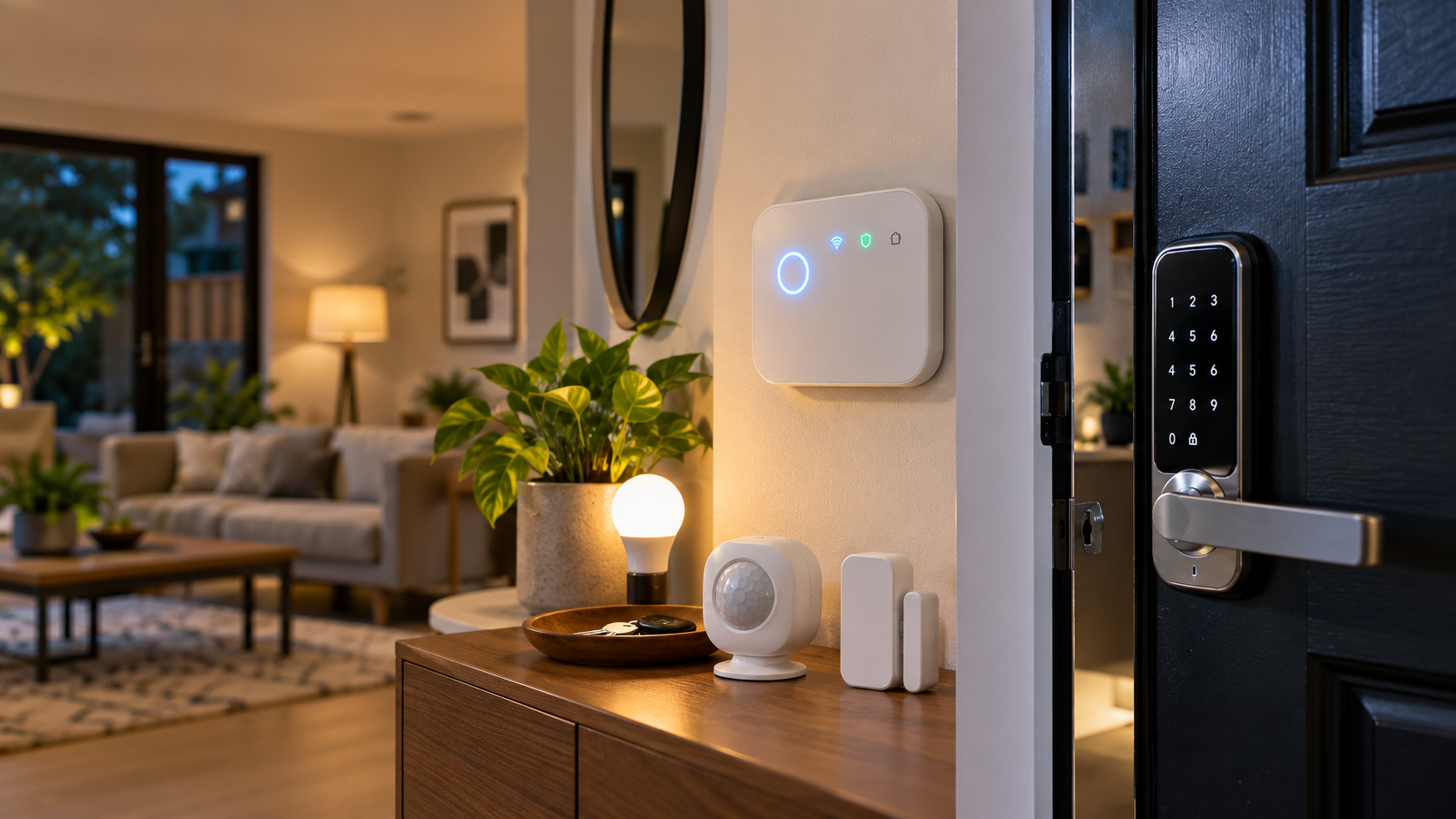
You don’t need a five-figure installation to make your home genuinely smarter. A smart home on a budget really comes down to three building blocks: lighting, access, and security  and you can cover all three without spending anywhere near what the glossy showroom demos suggest. Here’s how to build it up piece by piece, starting with whichever one solves your most immediate problem.
The Three Building Blocks of a Budget Smart Home

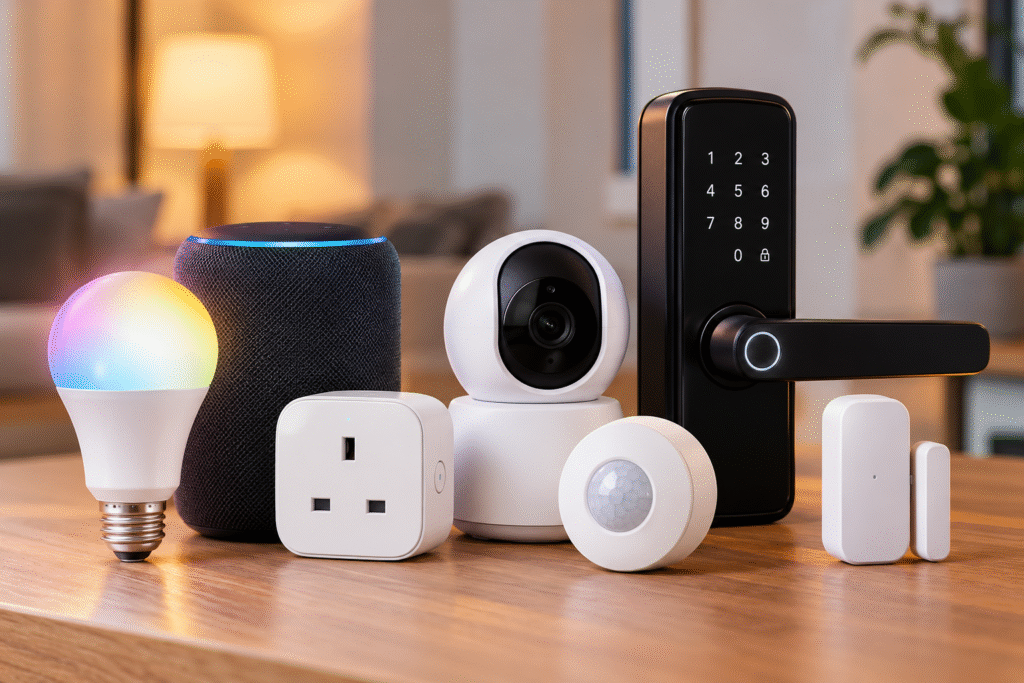
Most smart home starter kits fall into one of three categories, and you genuinely don’t need all three at once:

  • Lighting  the easiest, cheapest entry point, usually just a bulb swap
  • Access  smart locks that upgrade your existing door without replacing it
  • Security  alarms and sensors that watch your home when you’re not there

Start with whichever one actually solves a problem you have today, rather than buying all three because a bundle looks good.

Lighting: Smart Bulbs

This is the cheapest, lowest-commitment way into a smart home, and it’s where most people start. A Philips smart bulb screws straight into an existing fitting with no rewiring, no electrician  and gives you app and voice control over brightness, colour, and scheduling in minutes. Set lights to turn on automatically at sunset, dim gradually before bed, or switch to a warm tone for movie nights, all from your phone or by asking Alexa or Google Assistant.
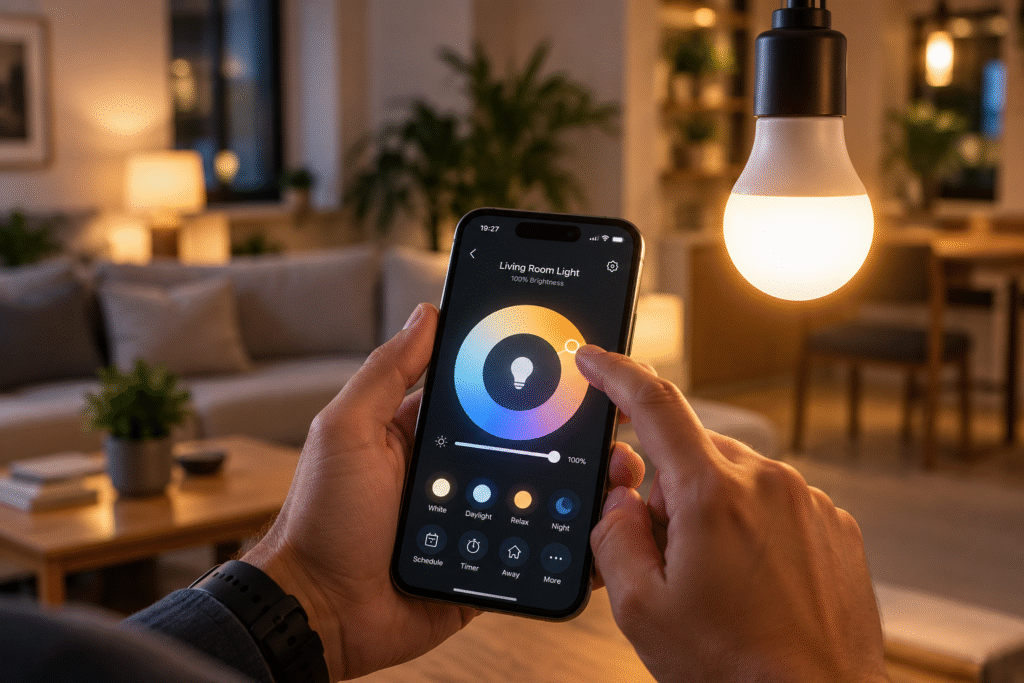
Because it’s just a bulb, it’s also the lowest-risk way to test whether you’ll actually use smart home features day to day before committing to anything that needs proper installation.
“Check the Philips LED Smart Bulb’s current price”

Access: Smart Locks

Once lighting feels second nature, a smart lock is usually the next logical step  and it doesn’t have to mean replacing your entire front door hardware. Retrofit options like the SwitchBot Lock fit over your existing deadbolt’s thumb turn, using a small motor to lock and unlock it without modifying the lock itself. That makes it genuinely renter-friendly: you keep your original keys working as a backup, and nothing about the physical lock changes.

Setup typically takes a few minutes with adhesive mounting, no drilling required, and it connects over Bluetooth, with an optional hub and keypad if you want remote access and voice control through Alexa or Google Assistant. For anyone comparing a smart lock UK option that won’t upset a landlord or void a tenancy agreement, this retrofit approach is usually the safest starting point.

“See the SwitchBot Lock’s current price”

Security: Smart Alarms

The final piece is whole-home monitoring, and this is where a kit like the Yale IA-320 comes in. Rather than a single device, it’s a self-contained alarm system: a hub, keypad, two motion sensors, a door/window contact sensor, and both indoor and outdoor sirens, all controllable through one app. It connects to Alexa and Google Assistant, covers a genuinely large 200-metre range (useful if you want to extend coverage to a garage or outbuilding), and runs with no mandatory subscription; everything is self-monitored through the app rather than routed through a paid monitoring service.
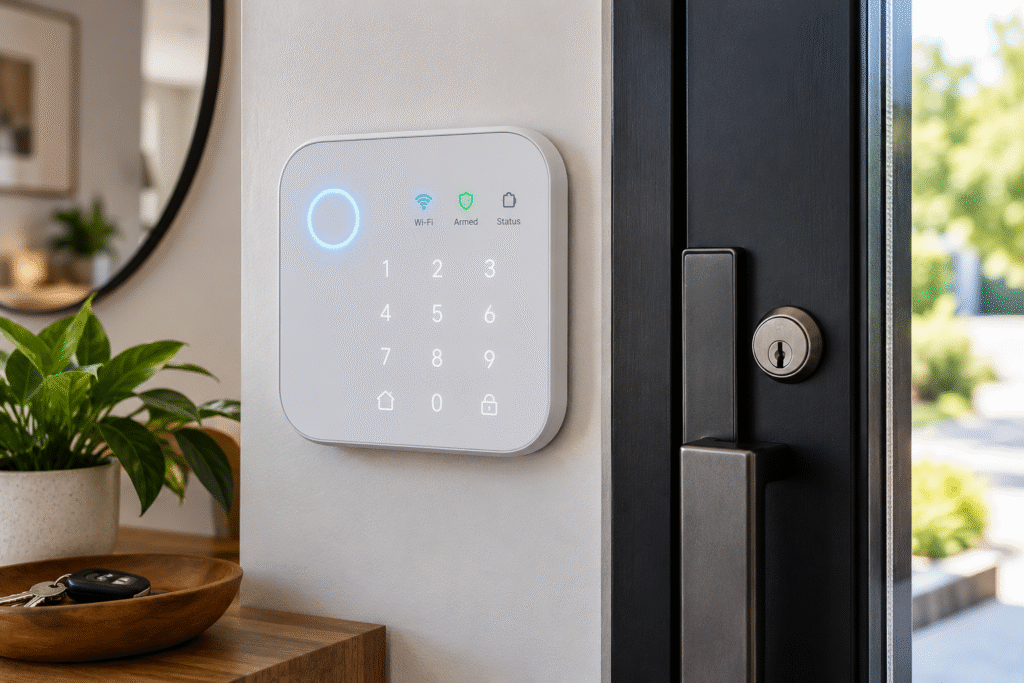
The trade-off is setup: with more components to pair and position than a single bulb or lock, it takes more patience to get right, and there’s no cellular backup if your Wi-Fi goes down. But for whole-home coverage without an ongoing monthly fee, it’s hard to beat on value.
“Check the Yale IA-320’s current price”

Building It Into a Starter Kit

If you’re building a genuine smart home starter kit rather than buying devices one at a time, a sensible order looks like this: start with bulbs to get comfortable with app and voice control, add a smart lock once you trust the ecosystem, then layer in an alarm kit for full coverage. All three of the products above work with both Alexa and Google Assistant, so you’re not locked into a single platform as you expand  a genuinely important detail, since mixing brands later is far easier when everything speaks the same smart home language from the start.

CategoryEntry PointWhat You Get
LightingSingle smart bulbApp/voice control, scheduling, no installation
AccessRetrofit smart lockKeyless entry, renter-friendly, keeps existing keys
SecuritySelf-monitored alarm kitMotion + contact sensors, sirens, no subscription

Final Thoughts

A genuinely useful smart home doesn’t require buying everything at once; it’s built in layers, starting with whatever solves your most immediate problem. A smart bulb gets you started for the price of a takeaway, a retrofit lock adds real convenience without upsetting a landlord, and a self-monitored alarm kit rounds things out with whole-home coverage and no ongoing fees. Add them in that order, on your own timeline, and you’ll end up with a setup that actually gets used which is the real measure of whether a smart home was worth building in the first place.

FAQ

What’s the cheapest way to start a smart home? A single smart bulb is the lowest-cost, lowest-commitment entry point  a Philips smart bulb screws into an existing fitting with no installation needed, giving you app and voice control in minutes.

Is a smart lock UK renters can actually use? Yes, provided you go for a retrofit model like the SwitchBot Lock, which fits over your existing deadbolt’s thumb turn without modifying the lock itself, so your original keys still work and nothing changes for your landlord or tenancy agreement.

Do I need a subscription for the Yale IA-320? No, the Yale IA-320 is self-monitored through its app, with no mandatory ongoing subscription, though it does lack cellular backup if your Wi-Fi connection drops.

What should be in a smart home starter kit? A sensible starter kit covers the three core categories: a smart bulb for lighting, a retrofit smart lock for access, and a self-monitored alarm kit for security  added in that order as your confidence and budget grow.

Do these devices work together across brands? Yes, the Philips bulb, SwitchBot Lock, and Yale IA-320 all support Alexa and Google Assistant, so you’re not locked into a single ecosystem as you add more devices over time.
Smart Homes
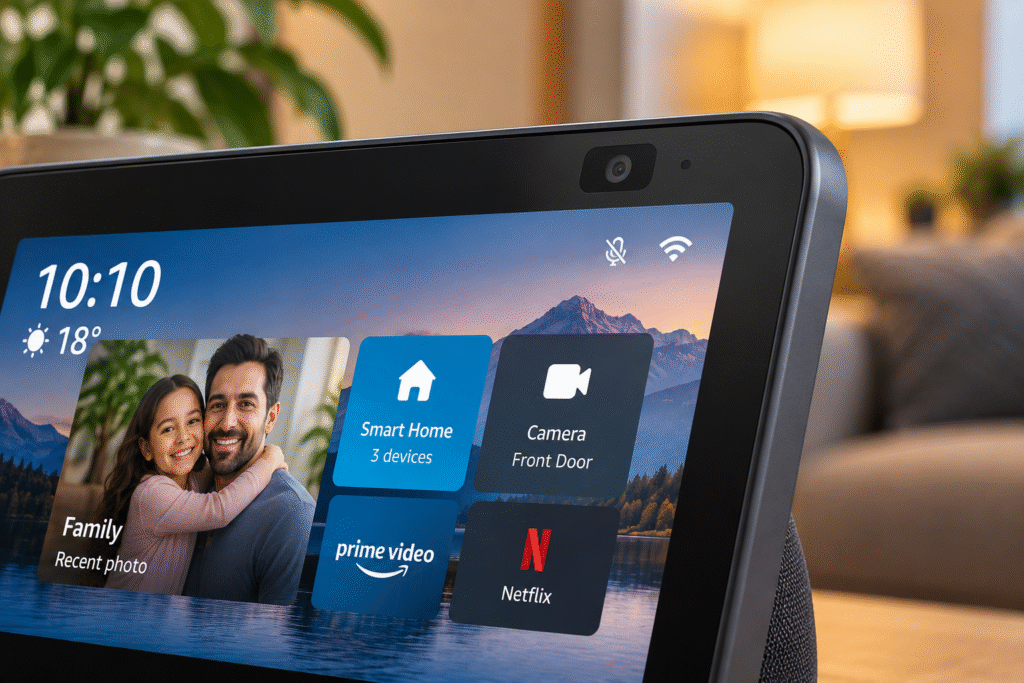
Echo Show 10 Review: The Smart Display That Follows You Around

If you’re searching for the Echo Show 10, here’s what you need to know before anything else: Amazon discontinued it in 2026, so it’s no longer available to buy new. What follows is the story of what made it special, and more usefully  which currently available Echo device to buy instead, depending on what you were actually after.

The Story Behind the Spin

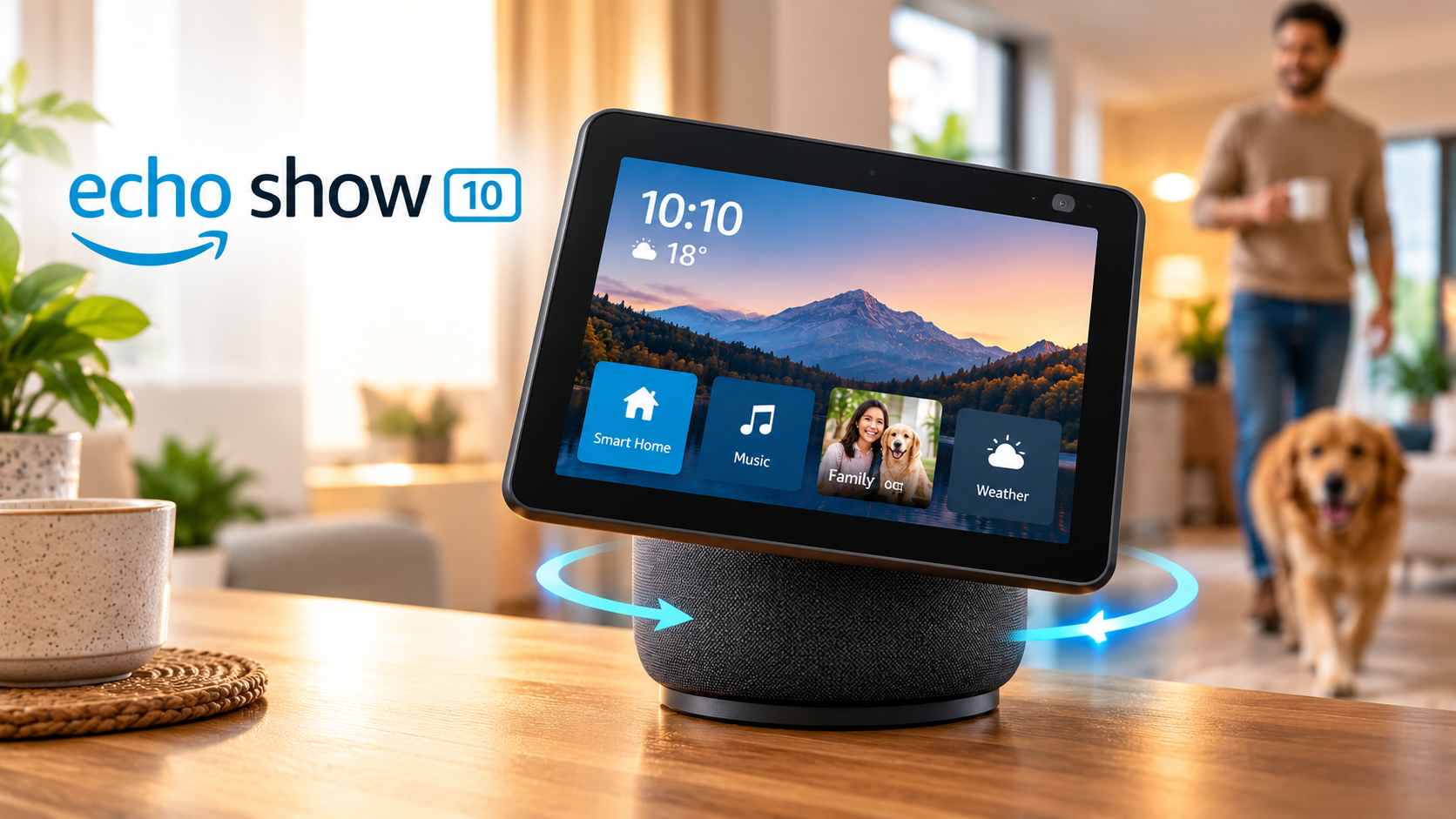
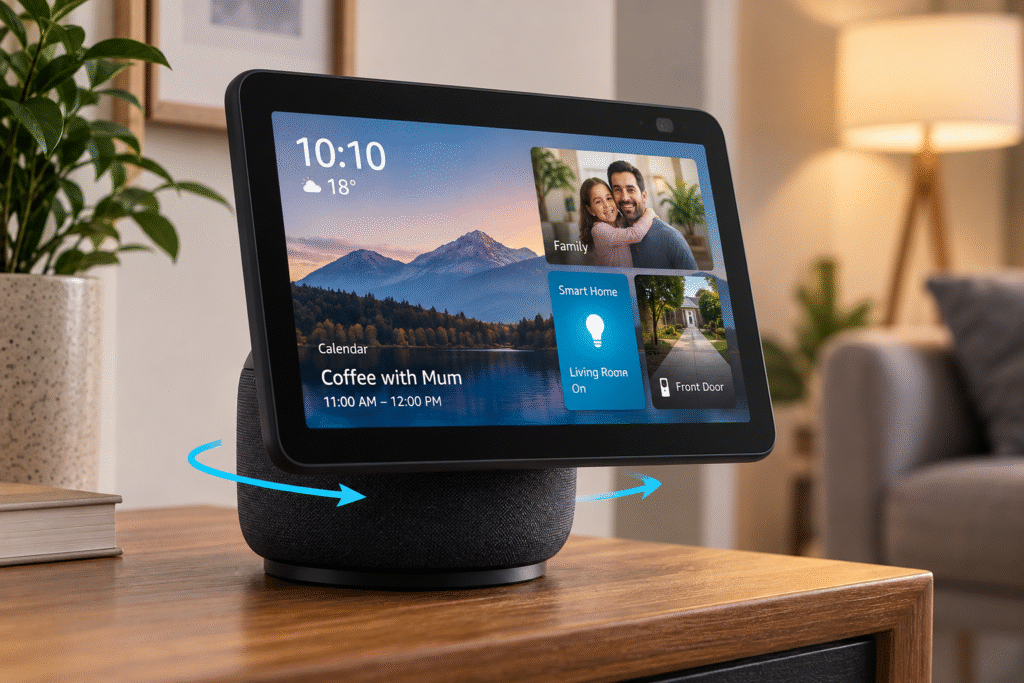
When the third-generation Echo Show 10 launched in 2021, it did something no other smart display had really tried: it moved. A motorised base, paired with a 13MP camera and auto-framing technology, let the whole 10.1-inch screen physically rotate up to 350 degrees to keep you centred  on a video call, following a recipe while you cooked, or just walking across the room. It wasn’t cheap, launching around £249, well above the rest of the Show lineup, but the engineering behind it was genuinely impressive, and paired with dual tweeters and a 3-inch woofer, it was a capable speaker in its own right too.

It’s exactly that ambition that seems to have led to its retirement. The motorised base added cost, bulk, and complexity that Amazon’s current display strategy  built around simpler, flatter screens across the Show 5, Show 8, and Show 11 has quietly moved away from. Remaining stock sold off through clearance, and by 2026 it had disappeared from Amazon’s official lineup entirely.

What People Actually Loved (and Didn’t) About It

The rotation genuinely solved a real problem: not having to manually reposition the device during a call or while cooking was a small convenience that became hard to live without once you’d used it, and reviewers consistently praised the audio quality for a device in its category. The drawbacks were just as real, though: it was considerably bulkier and heavier than a standard smart display, priced well above comparable non-rotating screens, and the always-tracking camera made some buyers uneasy, physical privacy shutter or not.

Then vs Now: What to Buy Instead

Since the Echo Show 10 itself can’t be bought new anymore, the right replacement depends entirely on which part of it you actually wanted:

Echo Show 8Echo Dot 5th Gen
Screen8-inch displayNo screen
RotationNoN/A
Best forVideo calls, recipes, visual Alexa useVoice control, music, smart home hub
PriceMid-rangeBudget
Replaces the Show 10’s…Screen and video callingAlexa assistant itself

If it was the screen you wanted, video calls, recipes, visual responses from Alexa the Echo Show 8 is the closest practical match, just without the motorised rotation, and at a noticeably lower price than the Show 10 ever carried. If it was really Alexa herself you were after, and the screen was just a bonus, the Echo Dot 5th Gen gives you the same voice assistant and smart home hub capability in a far smaller, cheaper device.

“See the Echo Show 8’s current price”

Which One Should You Actually Buy?

Specifically set on the rotating, follow-you-around feature itself? Nothing currently in Amazon’s lineup replicates it; a secondhand or refurbished Show 10 is genuinely your only route there.

Want a screen for calls and recipes, without paying extra for a discontinued feature? Go with the Echo Show 8.

Just want solid Alexa voice control and smart home integration? Go with the Echo Dot 5th Gen.

“Check the Echo Dot 5th Gen’s current price”

Final Verdict

The Echo Show 10 was a genuinely clever piece of engineering and one of the more memorable features Amazon has shipped in a smart display  but it’s gone, and chasing it secondhand only makes sense if the rotation itself was the whole point for you. For almost everyone else, the practical choice comes down to the Echo Show 8 or Echo Dot 5th Gen.

Best for: anyone researching the Echo Show 10 who needs a currently buyable alternative the Show 8 for the screen, the Dot for voice-only. Skip it if: you’re set on the rotating feature specifically no current device replicates it.

“Compare the Echo Show 8 and Echo Dot 5th Gen“

Smart Homes
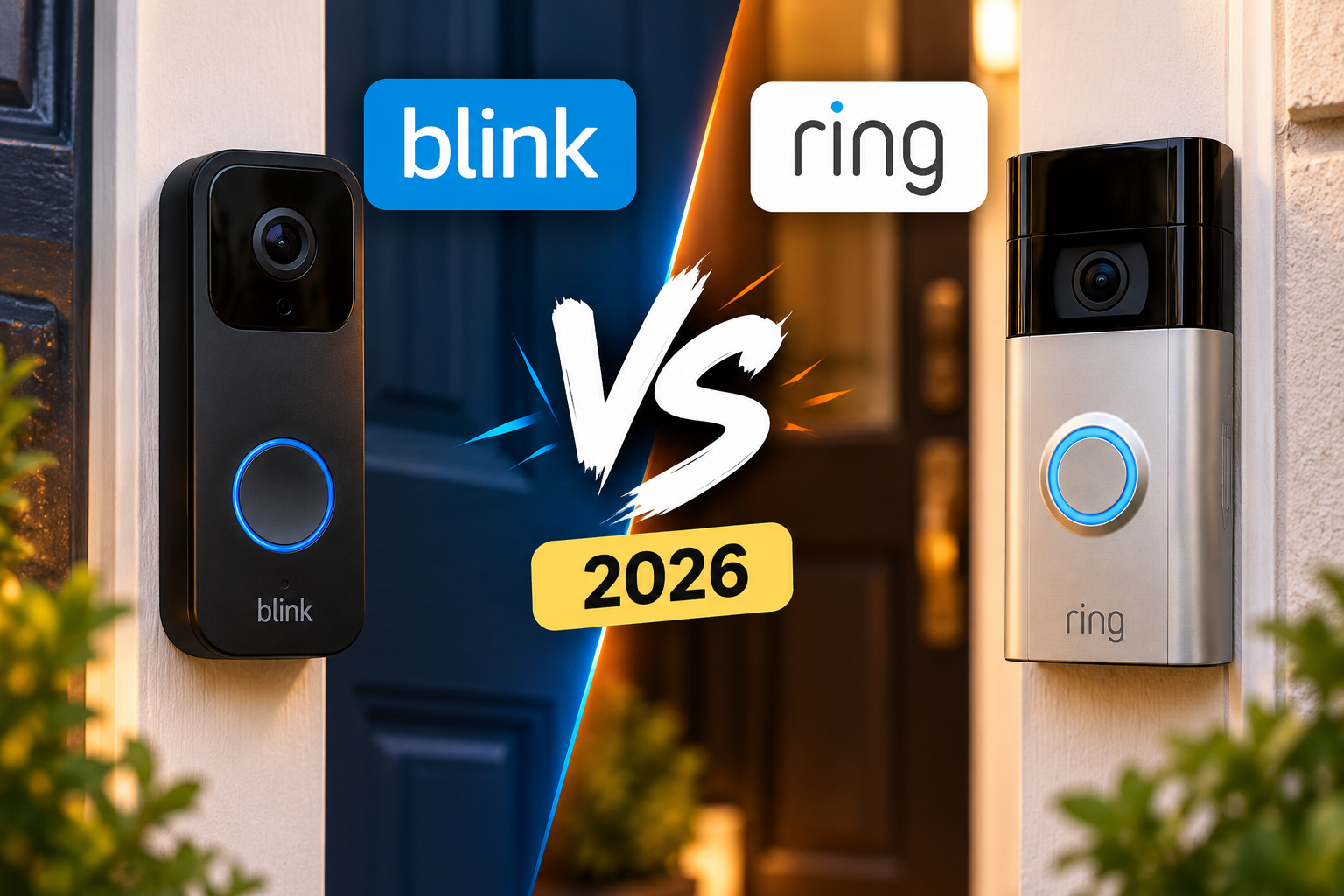
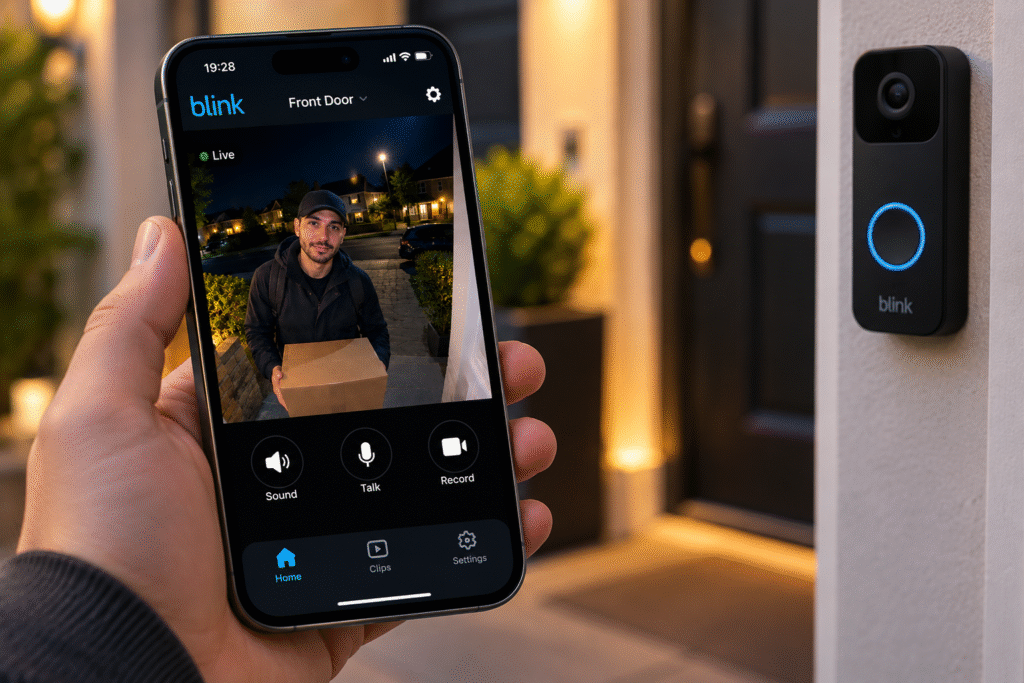
Blink Doorbell vs Ring Doorbell (2026): Which Video Doorbell Is Really Worth Buying?

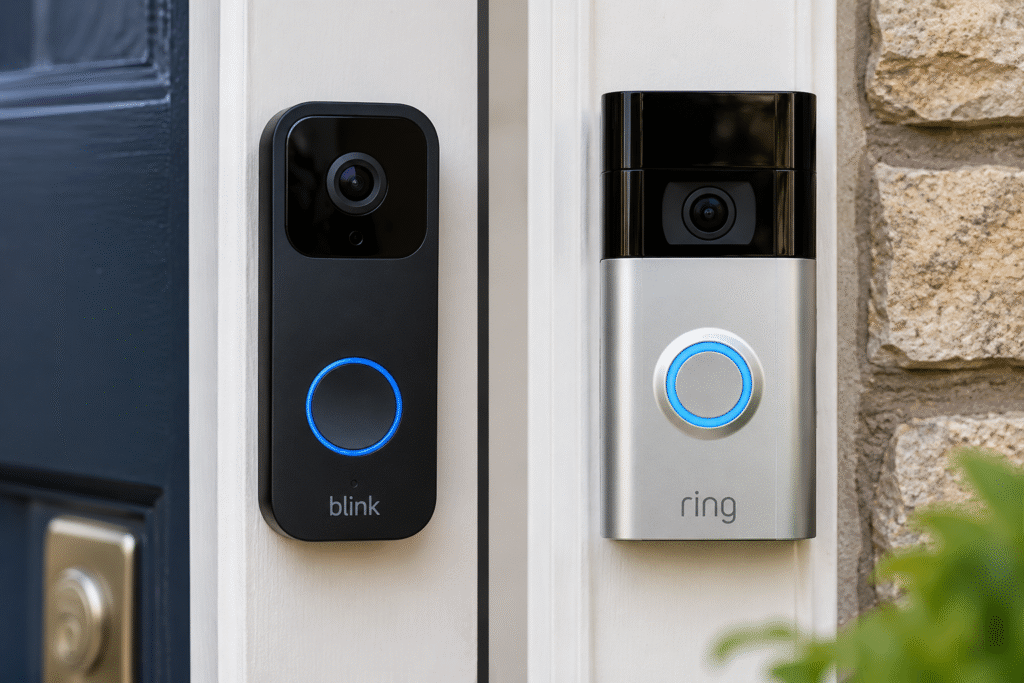
Both owned by Amazon, both instantly recognisable, and both constantly recommended in the same breath, Blink and Ring have become the default answer to “which video doorbell should I buy?” But they’re not interchangeable. Here’s how the Blink Doorbell actually compares to Ring’s equivalent model, so you can pick based on what you actually need rather than which one shows up first in search.

Quick Comparison

Blink Video DoorbellRing Battery Doorbell
ResolutionUp to 2K (1440×1440)1536p HD (1440×1440)
Night visionInfraredColour night vision
Field of view150 degrees150 x 150 degrees
Power2–3 AA batteries, up to 2 yearsRechargeable battery pack, ~6–12 months
SetupRequires Blink Sync ModuleStandalone Wi-Fi, no extra hub
EcosystemAlexa, Blink camerasAlexa, wider Ring smart home range
Price positioningBudgetMid-range

Video Quality and Night Vision

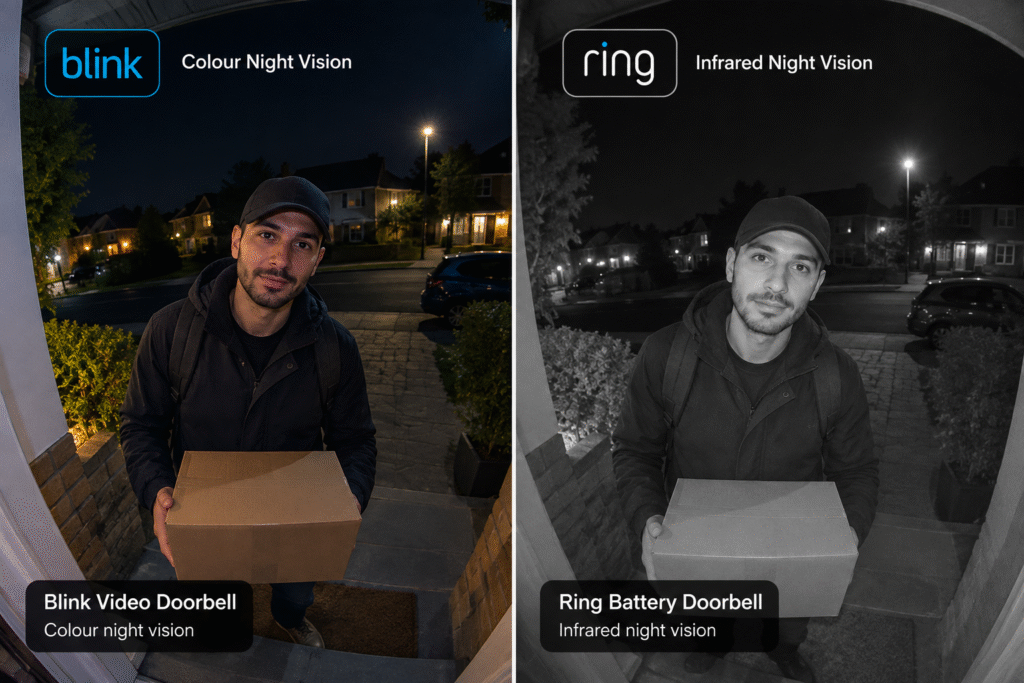
Both doorbells film at a similar resolution, so daytime footage looks comparably sharp on either. Where they genuinely differ is after dark: the Ring Battery Doorbell offers colour night vision, meaning footage after sunset still shows actual colours rather than the black-and-white infrared image the Blink Video Doorbell produces. If you specifically want to identify a visitor’s clothing or a car colour at night, that’s a real practical advantage for Ring.

Battery Life and Power

This is where the Blink video doorbell pulls ahead decisively. Running on standard AA batteries, it’s rated for up to two years of use before needing a change to a genuinely low-maintenance setup. The Ring Battery Doorbell uses a rechargeable battery pack instead, which typically needs recharging somewhere between every six and twelve months depending on how much activity it detects, meaning more frequent trips up a ladder to unclip and recharge it. If you’d rather not think about your doorbell’s power for years at a time, Blink has the clear edge here.

Setup and Ecosystem

Setup complexity differs more than most buyers expect. The Blink Video Doorbell needs a Blink Sync Module plugged in indoors to unlock its full feature set and connect smoothly with other Blink devices, an extra step, though a one-time one. The Ring Battery Doorbell, by contrast, connects directly to your home Wi-Fi with no additional hub required, making it marginally simpler to get running out of the box.

Where Ring pulls ahead long-term is ecosystem breadth. If you’re thinking beyond just doorbell  motion sensors, alarm systems, indoor cameras, Ring’s wider smart home range gives you more to expand into later. Blink’s lineup is comparatively focused, built mainly around simple, affordable blink camera options for doorbell and basic outdoor security rather than a full smart home security system.

Price and Subscription Costs

Blink consistently positions itself as the budget option, and the doorbell reflects that  it’s the more affordable choice upfront. Ring’s battery doorbell costs more, but the difference reflects its extra features: colour night vision, a more polished companion app, and deeper integration with the rest of a Ring-based smart home setup. Both brands save video clips behind a monthly subscription; live view works without one on either device, but if you want clips stored and reviewable later, budget for that ongoing cost regardless of which you pick.

For anyone specifically comparing a Ring doorbell UK listing against Blink, it’s worth checking current pricing directly, since both brands run frequent discounts that can shift the value equation significantly from list price.

Which Should You Buy?

Here’s the honest breakdown by priority:

  • Want the lowest-maintenance option and don’t want to think about batteries for years? Blink wins on battery life alone.
  • Want the clearest possible night-time footage? Ring’s colour night vision is the more useful real-world feature.
  • Planning to build out a full smart home security system later? Ring’s broader ecosystem gives you more room to grow.
  • Just want a simple, affordable doorbell camera and nothing more? Blink’s simpler, cheaper setup does the job without overcomplicating things.
  • Want the easiest possible setup with no extra hub? Ring’s standalone Wi-Fi connection is marginally simpler out of the box.

Our Picks

Best budget, low-maintenance pick — Blink Video Doorbell Two years of battery life, straightforward setup, and a genuinely affordable price point make this the sensible choice for anyone who just wants reliable doorbell coverage without the extras. “Check Price”

Best for video quality and smart home growth — Ring Battery Doorbell Colour night vision and a wider ecosystem to expand into make this the stronger pick if you want the best footage quality and room to build out a fuller smart home security setup later. “Check Price”

The Bottom Line

Neither doorbell is objectively better; they’re built around different priorities. The Blink Video Doorbell wins on simplicity, battery life, and price. The Ring Battery Doorbell wins on night vision quality and long-term smart home flexibility. If you’re only looking for dependable front-door coverage without ongoing maintenance, Blink is the easy recommendation. If picture quality and future expansion matter more to you than upfront cost, Ring earns the extra spend.


Smart Homes
Do Air Purifiers Actually Work? What the Science Says

Air purifier marketing loves big promises “removes 99.9% of allergens,” “clinically proven,” “doctor recommended.” But strip away the marketing copy and ask a simpler question: does the actual research back any of this up? We went looking for what the science genuinely says about air purifiers, rather than what the box claims, so you can decide if one is actually worth buying.

What Air Purifiers Actually Do

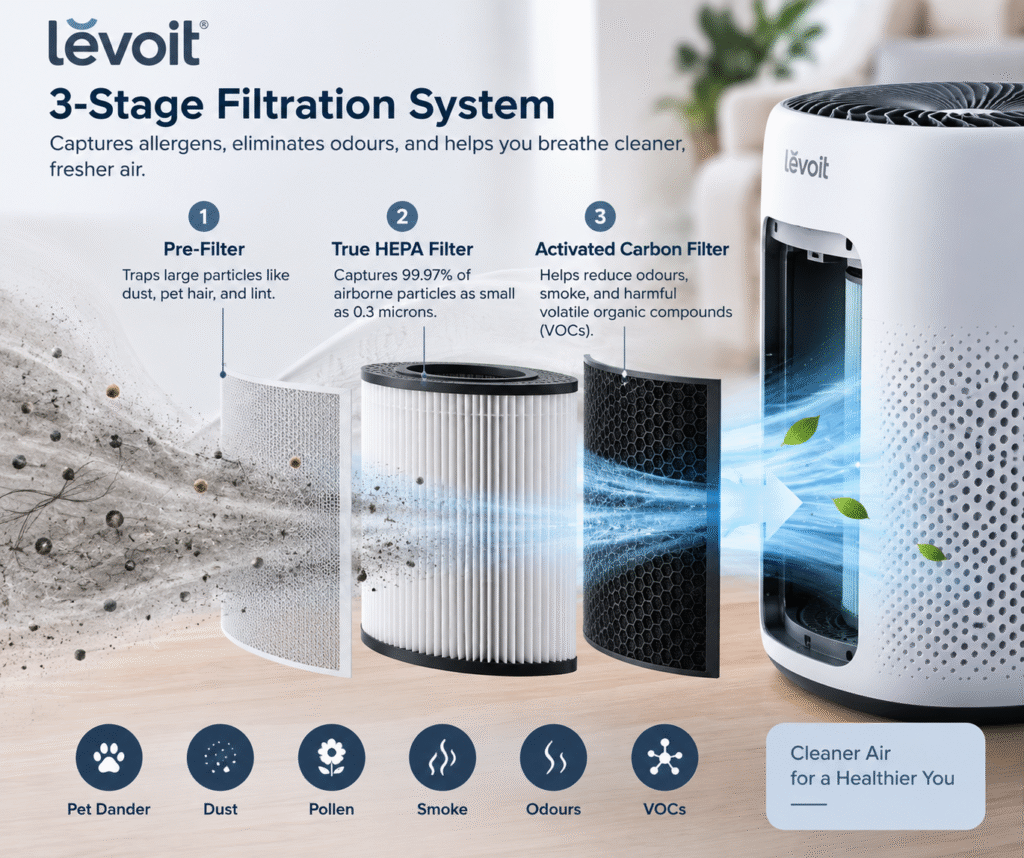
Strip away the branding and most air purifiers work on a simple mechanical principle: pull air through a filter fine enough to trap particles, then push clean air back out. The gold standard here is the HEPA filter, which the U.S. The Environmental Protection Agency defines it as capable of trapping at least 99.97% of airborne particles as small as 0.3 microns, a size range that covers most dust, pollen, pet dander, and even many bacteria and mold spores. That’s not a marketing number; it’s a genuine engineering standard, which is why “True HEPA” certification matters more than a purifier simply claiming “HEPA-style” filtration.

The Evidence for Asthma

This is where the research is strongest. In a review of multiple studies, the EPA found statistically significant improvement in respiratory health and allergy or asthma symptoms linked to air cleaner use. One 2023 study published in the Journal of Asthma placed HEPA air cleaners in school classrooms and found measurable lung function improvements in some students with asthma compared to classrooms without them. Dust mites are a particularly relevant trigger here  research suggests that between 30% and 60% of children with asthma are sensitised to them, which is part of why reducing airborne particle load can genuinely help.

Air Purifier Benefits for Allergies: What’s Actually Proven

The honest picture on air purifier benefits for allergies is more nuanced than most product pages suggest. A 2020 analysis of studies involving people with allergic asthma found that air purifiers improved quality of life and reduced airway inflammation with genuinely positive results. But the same analysis found no consistent improvement in day-to-day symptoms, lung function, or medication use. In plain terms: purifiers can measurably help how people feel and reduce inflammation markers, without necessarily eliminating sneezing fits or letting you skip your antihistamine.

For specific allergens, the evidence gets more mixed. A widely cited 2010 study found HEPA filters may be effective for removing pet allergens specifically in uncarpeted rooms, or when combined with HEPA vacuuming on carpeted floors. However, a Cochrane review, one of the most rigorous forms of scientific evidence,  concluded the evidence isn’t strong enough to confidently recommend air purifiers where pets live in the home of someone with a pet allergy. Dust mites and mold present a similar story: purifiers aren’t reliably effective at removing them directly, since these particles often settle into fabric and carpet rather than staying airborne, though reducing general airborne particulates can still offer some symptom relief.

Where the Evidence Is Weaker

It’s worth being upfront about the limits here, since a genuinely evidence-led answer has to include them. Air purifiers primarily clean airborne particles  they do nothing for allergens already settled in carpets, bedding, or upholstery, which is why organisations like the American Academy of Allergy, Asthma, and Immunology are clear that purifiers are only one piece of a broader strategy. Ventilation, regular cleaning, and reducing allergen sources at home all still matter, arguably more than the purifier itself in isolation.

So, Are Air Purifiers Worth It?

Based on the actual research, the honest answer is: yes, but as a supplement, not a cure. The evidence is genuinely strong for reducing airborne particulate matter and supporting people with asthma, reasonably solid for general allergy symptom relief and quality of life, and weaker specifically for allergens that settle rather than stay airborne, like dust mites and pet dander in carpeted rooms. If you’re expecting a purifier to eliminate allergies entirely, the science doesn’t support that. If you’re expecting it to meaningfully reduce your airborne allergen load and support easier breathing alongside good ventilation and regular cleaning, that’s exactly what multiple independent reviews back up.

What to Look For If You Want the Proven Benefits

If the goal is genuinely getting the science-backed advantages rather than just a nice-looking device, a few things matter more than brand names: look for certified True HEPA filtration rather than vague “HEPA-style” claims, match the unit’s clean air delivery rate (CADR) to your actual room size rather than assuming bigger numbers always help, and run it consistently rather than only when you remember to, since the research behind these benefits assumes regular, ongoing use.

For smaller rooms, specifically bedrooms, nurseries, home offices  a compact, quiet purifier tends to get used more consistently than a bulky unit people switch off because it’s noisy or in the way.

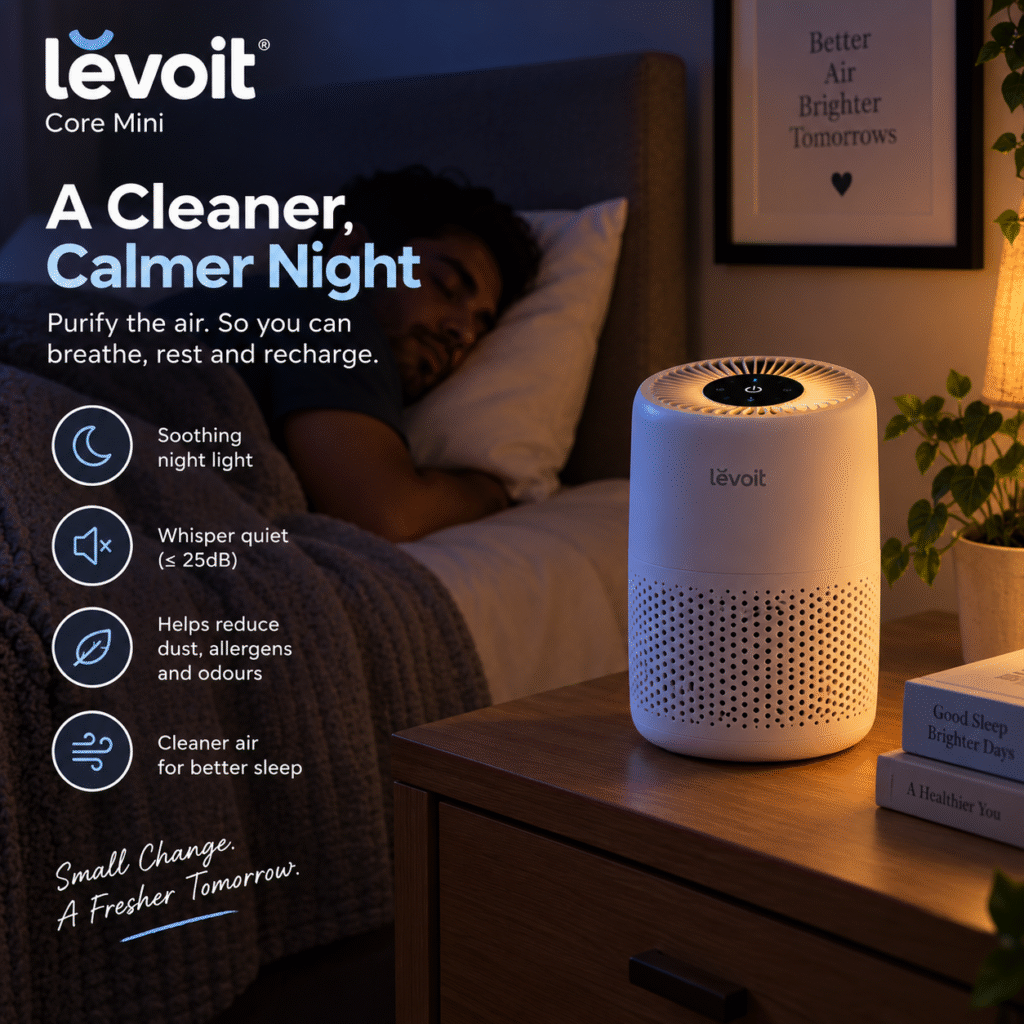
The Levoit Core Mini is a solid example of this approach: proper multi-stage filtration sized appropriately for small spaces, quiet enough to run overnight without a second thought.

“See the Levoit Core Mini”

The Bottom Line

Air purifiers aren’t snake oil, but they aren’t a miracle cure either. The genuine, research-backed benefit is a measurable reduction in airborne particulates that can support easier breathing, particularly for asthma, when used consistently and as part of a broader approach to indoor air quality  not as a replacement for it. If you or a family member have a diagnosed respiratory condition, it’s worth discussing indoor air quality strategies with a doctor alongside any purifier purchase, since individual triggers and needs vary considerably.

Smart Homes
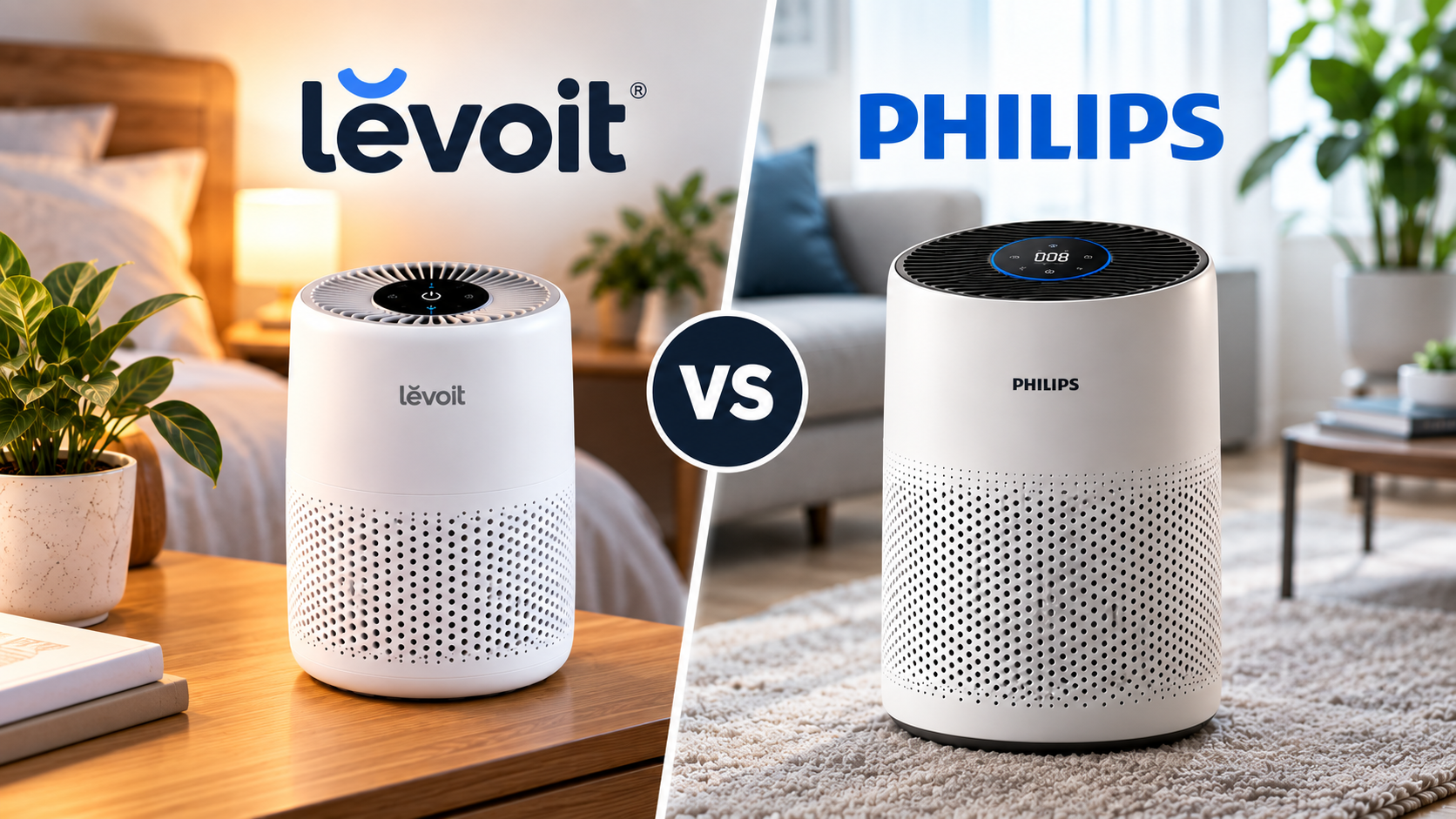
Levoit vs Philips Air Purifiers: Which Brand Should You Trust?

Type “best air purifier” into Google and two names dominate the results again and again: Levoit and Philips. Both have loyal followings, both show up constantly in comparison articles, and both genuinely make good products  which is exactly why picking between them can feel harder than it should. Here’s how the two brands actually differ, so you can decide which philosophy fits your home rather than just picking whichever one ranks higher on a random “best of” list.

Two Very Different Philosophies

The clearest way to understand the difference between these brands isn’t spec-by-spec, it’s philosophy-by-philosophy. Philips positions itself as the premium, engineering-led option: proprietary NanoProtect filtration, real-time AeraSense air quality sensors that actually detect PM2.5 particles as they happen, and a general focus on advanced performance for buyers who want the best technology available and are willing to pay for it.

Levoit, by contrast, built its reputation on value. As a direct-to-consumer brand, it’s able to offer strong, genuinely capable filtration  including True HEPA filters on several of its models  at a noticeably lower price point than Philips’ equivalent tiers. It’s the brand for buyers who want reliable, no-nonsense clean air without paying a premium for extras they might not use.

Neither approach is objectively “better”  ; they’re built for different buyers, which is really the whole point of this comparison.

Price and Value

This is where the gap between the two brands is most obvious. Philips models routinely cost noticeably more than a comparable Levoit unit with similar coverage  in some direct comparisons, a Philips model has been priced more than double an equivalent Levoit for a similar-sized room. That premium buys you Philips’ sensor technology and brand engineering, but if pure value-for-money is your priority, Levoit consistently comes out ahead on that specific metric.

Filtration and Performance

Both brands use multi-stage filtration, a pre-filter, a main filtration stage, and an activated carbon layer for odours  but the details matter. Philips’ NanoProtect filters are proprietary and, on many models, don’t carry official “True HEPA” certification despite strong real-world performance in independent testing. Several Levoit models, on the other hand, do use certified True HEPA filters, which can matter if you’re specifically shopping for allergy or asthma relief and want that certification as reassurance.

On raw clean air delivery rate (CADR), Philips’ higher-tier models tend to edge out comparably priced Levoit units, particularly for larger rooms  the trade-off being, again, a higher price for that extra performance headroom.

Smart Features and App Control

Both brands offer app-connected models, but they take slightly different approaches. Philips’ higher-end units lean on their built-in air quality sensors to automatically adjust fan speed in real time, which is a genuinely useful hands-off feature. Levoit’s app (VeSync) covers scheduling, fan speed control, and filter-life tracking across a wide range of models, including budget ones  meaning you don’t have to buy Levoit’s most expensive unit to get decent smart features, which isn’t always true of Philips’ range.

Noise Levels

Independent testing tends to show both brands performing similarly at low-to-mid fan speeds, with real differences only showing up at max speed, where raw airflow inevitably gets louder regardless of brand. Neither brand has a clear, consistent edge here; it varies more by specific model than by brand overall, so this one’s worth checking on a model-by-model basis rather than assuming either brand is quieter across the board.

Product Range and Availability

Levoit has one of the widest product ranges in the affordable air purifier space, covering everything from compact single-room units to larger models built for open-plan spaces, all sold primarily online. Philips’ range spans a similarly broad set of room sizes, but with pricing that climbs more steeply as coverage and features increase, and wider availability through traditional electronics retailers alongside online marketplaces.

Which Brand Should You Trust?

Here’s the honest breakdown by priority:

  • Want the best value for a small-to-medium room? Levoit wins  strong filtration, often True HEPA, at a lower price.
  • Want the most advanced sensor tech and are willing to pay for it? Philips wins  real-time air quality sensing and higher CADR on premium models.
  • Shopping for a best air purifier UK pick on a tight budget? Levoit’s range gives you more capable options at accessible price points.
  • Purifying a larger, open-plan space and performance matters more than price? Philips’ higher-tier models generally have the edge on raw CADR.
  • Want smart features without paying for a flagship model? Levoit spreads app control across more of its range, including budget units.

“Read our full Levoit Core Mini review”

The Bottom Line

Both Philips and Levoit ranges are trustworthy  this isn’t a case of one brand being genuinely bad. It comes down to whether you value Philips’ premium sensor technology and performance headroom, or Levoit’s stronger value-for-money and broader access to features like True HEPA filtration across cheaper models. For most UK homes shopping on a budget, Levoit tends to offer more capability per pound. For anyone prioritising the most advanced air quality monitoring available and willing to pay for it, a Philips air purifier remains a strong, well-engineered choice.

Smart Homes
Levoit Core Mini Review: Compact Air Purifier for Small Rooms

Not every room needs a big, room-dominating air purifier; sometimes you just want clean air on a bedside table, a desk, or a nursery shelf without the bulk or the noise. That’s exactly the gap the Levoit Core Mini is built to fill. We’ve dug into how it actually performs against independent lab testing to see whether it delivers, or whether “mini” just means “underpowered.”

The Quick Take

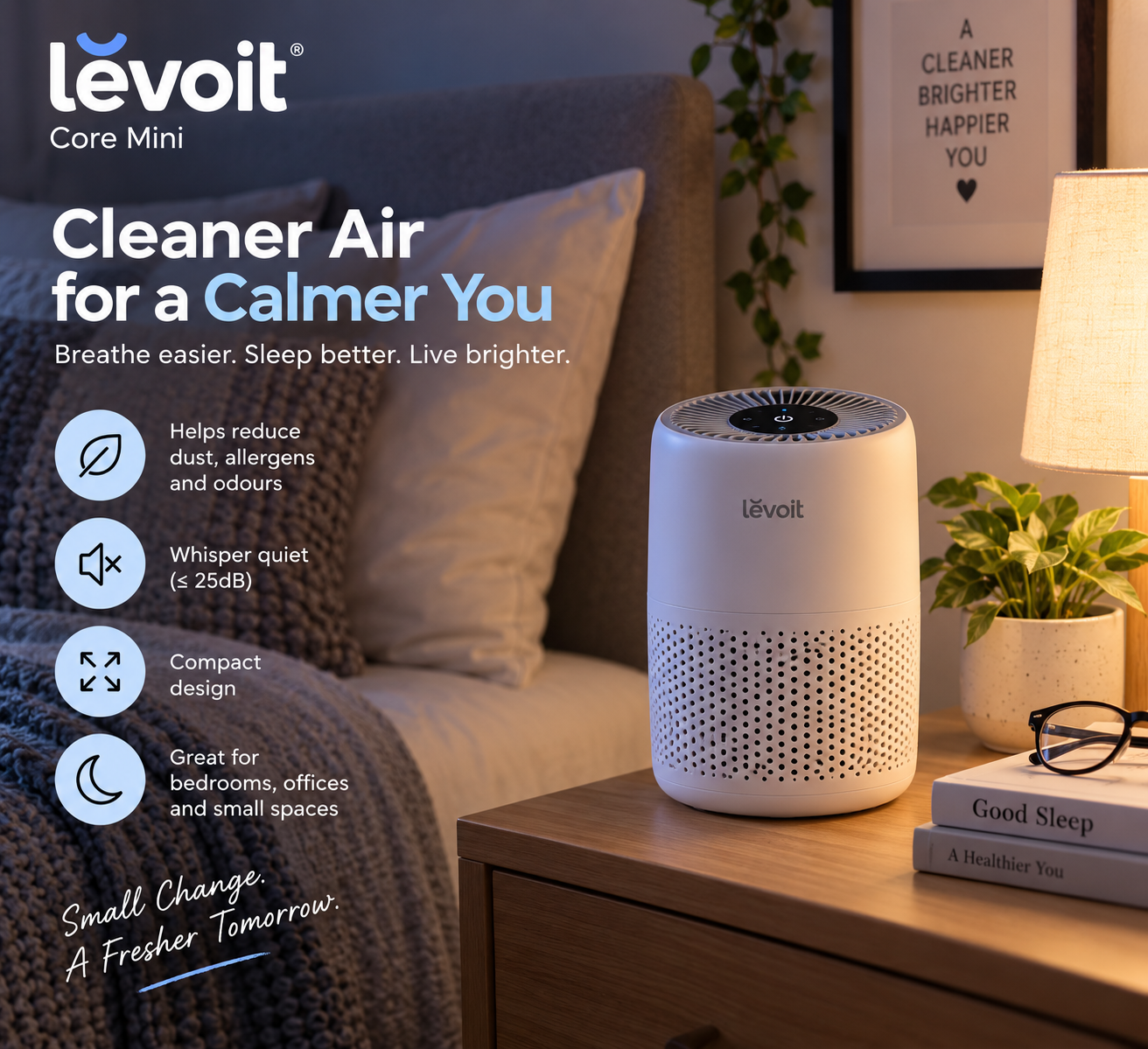
The Levoit Core Mini is a genuinely well-built small-space air purifier  quiet, energy-efficient, and compact enough to fit almost anywhere. It’s not designed to tackle a living room or open-plan space, and it’s honest about that: this is a purifier built specifically for bedrooms, nurseries, home offices, and other small rooms, and within that lane, it performs well.

“Check Price on Amazon”

Design and Build

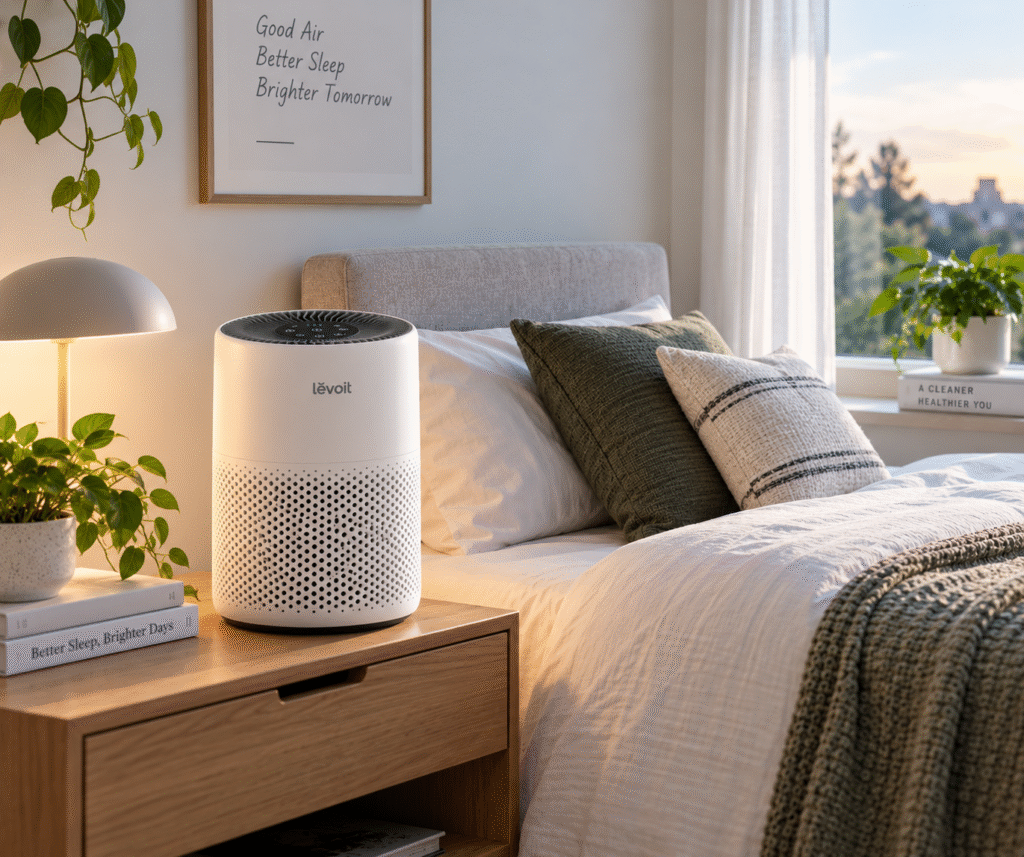
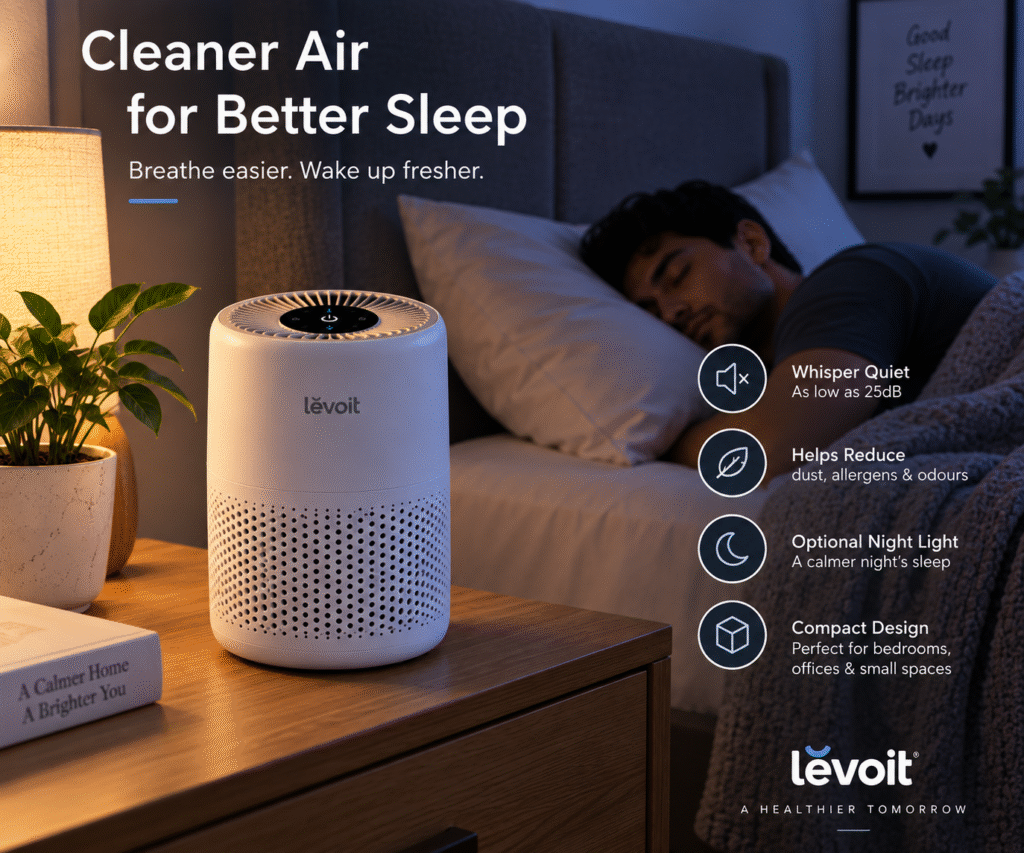
The Core Mini keeps the same clean, minimalist look Levoit is known for, just shrunk down. It’s genuinely compact, small enough to sit on a nightstand or desk without dominating the space  and the plain control panel means there’s no confusing setup process. A soft night light doubles as a subtle glow for bedrooms, and the whole unit is light enough to move between rooms without any hassle, which suits its role as a personal-space purifier rather than a fixed room fixture.

Filtration and Performance

This is where it’s important to be upfront about what the Core Mini is and isn’t. It uses a 3-stage filtration system, a pre-filter to catch larger particles like hair and dust, a main filter, and activated carbon for odours  but unlike Levoit’s larger Core models, it does not use a certified True HEPA filter. Independent testing puts its clean air delivery rate (CADR) in the roughly 34–46 CFM range, which is modest, but entirely appropriate for the small spaces it’s designed for.

In practical terms, that translates to effective air changes in rooms up to roughly 60–100 square feet  think a bedroom, home office, or nursery, not an open-plan living room. Independent smoke testing found it capable of clearing a small test space of visible smoke, which is a genuinely positive result for a purifier this size, though it’s worth setting expectations accordingly: this isn’t the unit to reach for if you’re trying to purify a larger, open living space.

The Aroma Pad: A Nice Extra

One feature that sets the Core Mini apart from most budget purifiers is its built-in aroma pad, which lets you add a few drops of your own essential oil for a light scent alongside the filtered air. It’s a small touch, but it’s the kind of detail that makes the Core Mini feel a little more considered than a plain fan-and-filter box, especially for bedroom or nursery use where a subtle scent is genuinely appreciated.

Noise and Energy Use

If quiet operation matters to you and for a bedside unit, it usually does. Independent testing measured it at around 41–42 dBA on its lowest speed, quiet enough to run overnight without being intrusive. It’s also impressively energy-efficient, drawing around 7 watts of power, which works out to a genuinely negligible running cost over a year of continuous use.

Filter Maintenance

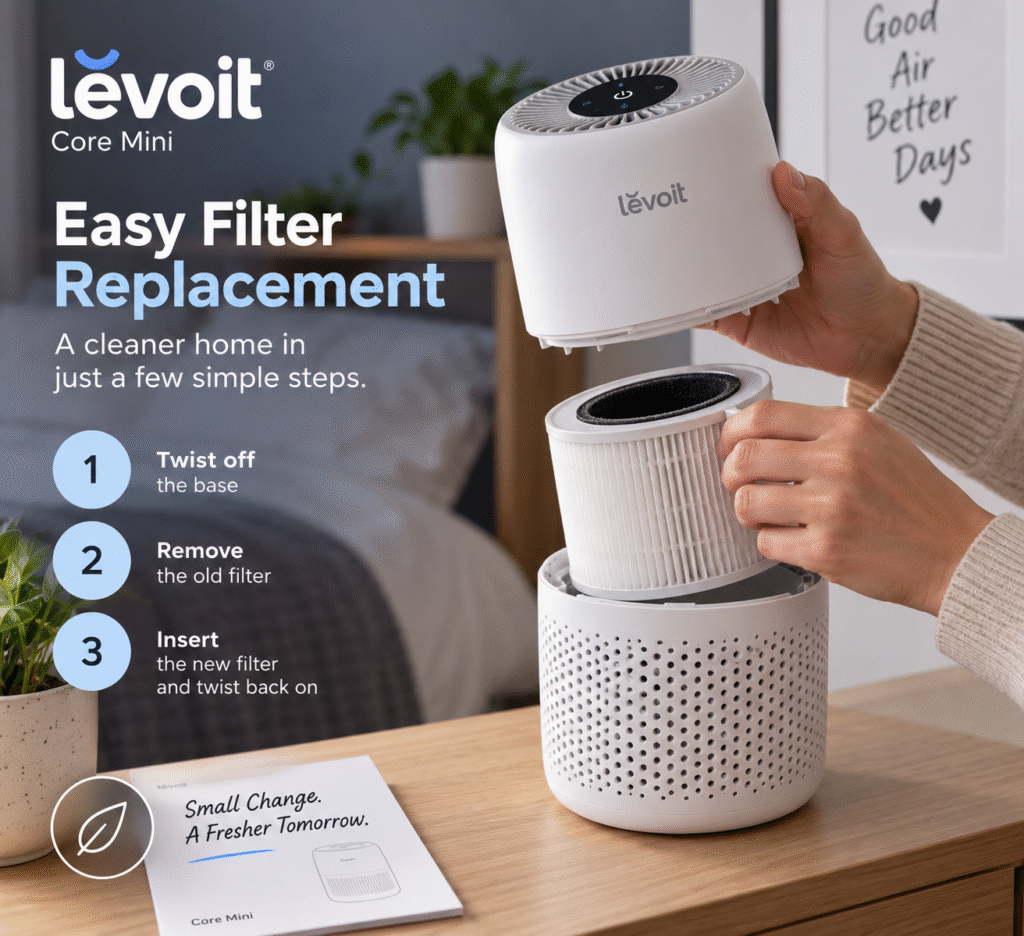
The Core Mini uses a dedicated Core Mini-RF replacement filter, generally priced in the £15–£25 range, with most owners replacing it every 6–8 months depending on usage. That’s a reasonable ongoing cost for a unit in this price bracket, and genuine Levoit filters are widely available rather than being a hunt.

“See current pricing on the Levoit Core Mini →”

Pros and Cons

Pros:

  • Genuinely quiet — ideal for bedrooms and nurseries
  • Very low energy consumption
  • Compact, minimalist design fits anywhere
  • Unique aroma pad feature for light scenting
  • No ionizer — just efficient fan and filter design
  • Affordable filter replacements

Cons:

  • Not a True HEPA filter, unlike larger Core models
  • Limited to small rooms (roughly 60–100 sq ft)
  • Won’t handle heavy smoke, large spaces, or strong odours
  • Fewer advanced features than pricier Levoit models

Who Is the Levoit Core Mini For?

This is the right pick if you want a dedicated, quiet air purifier for a single small room, a bedroom, nursery, home office, or student room and don’t need it to double up for a larger living space. As a small air purifier UK buyers are searching for specifically, it fits that brief well. If your goal is purifying an open-plan kitchen-diner or a larger living room, you’ll want to look at Levoit’s larger Core models instead, which trade the compact size for genuinely higher CADR and True HEPA filtration.

Final Verdict

The Levoit Core Mini doesn’t try to be more than it is, and that honesty is exactly why it works. As a Levoit air purifier built specifically for personal, small-space use, it delivers quiet, energy-efficient, genuinely effective air cleaning within its intended room size. Just go in with realistic expectations about coverage, and it’s one of the smartest small-space picks available.

Smart Homes
Transforming Traditional Appliances to Smarter Appliances with Intelligent Technology
Smart Appliances

Smart Appliances changes our lives in every simple thing which we do/complete. Technologies or mobile phones are increasingly used to control once manual procedures. Some of the most noticeable changes have been in our homes, especially in our everyday appliances.

The transition from traditional to smart appliances for everything from cleaning to cooking has made life simpler, safer, and more affordable.

This blog discusses how to upgrade or adapt your appliances with smart technology. And looks at the advantages of doing so.

Why to Buy Smarter Appliances for my House?

People have shifted to smart appliances for a variety of reasons. And the advantages are even more than what you imagine!

  • It Is Practical
    Speech commands, computerized devices, and remote control; all of these features of intelligent appliances. Imagine preheating your oven on your way home or turning on your washing machine while you’re at work.
  • Efficiency of Energy
    Smart appliances monitor and decrease on water and power use. This eventually reduces utility costs and helps the environment.
  • Customization
    These smart devices learn your habits and adjust to your preferences. For example, your smart coffee machine might prepare the perfect cup at the exact time you want it.
  • Safer and Secured
    Features like leaking alarms, overheat detection, CCTV cameras and auto shut-off can help prevent accidents and costly damage to your home.
  • Tracking
    By having notifications and performance statistics sent to your phone, you can be informed about maintenance, usage, and issues that need to be addressed.
Enhancing the Experience: The Advantages of each Corner in your House 

Let’s look at how innovative technology can be used to change various parts of the house. There are smart upgrades everywhere, from your bedroom to your kitchen.

1.Cooking and Cleaning the Kitchen
 

Intelligent Fridges and Freezers
These refrigerators, which include touchscreens, cameras, and temperature control. It lets you check what’s inside from your phone and receive alerts when time is up. 

Smart Ovens and Microwaves
Some kinds of these appliances can even detect what you’re cooking and automatically select the ideal temperature and time. They can also be remotely preheated.

Coffee Makers
Make coffee while you’re in bed or plan it for your morning ritual. Depending on your tastes, some machines can even change the brew strength.

Intelligent Dishwashers
These are efficient and environmentally beneficial since they can determine how dirty your dishes are and modify the water usage accordingly.

2. Comfort and Cozy in the Living Rooms
  • Intelligent Televisions
    With voice search, built-in apps, and streaming features, smart TVs offer hands-free operation and personalized recommendations.
  • Systematic Lighting 
    You can set routines, adjust the colors, and dim the lights with voice assistants like Google Home or Alexa. You may also create mood lighting settings for different times of the day.
  • Smarter Plugs and Switches 
    Any everyday machine, including fans or lamps, can be made smart with a Wi-Fi-capable connector. These let you remotely turn devices on and off and set timers.
3. Innovative Bedrooms

Clever Thermostats
These gadgets/appliances automatically regulate the temperature for maximum comfort and energy efficiency based on your sleeping patterns.

Automatic Curtains
You can program your curtains to open at sunrise or open them with a voice command.

Monitors for the Air Quality
Track dust, allergens, temperature, and humidity to keep your home air clean. This is especially useful for people who have asthma or allergies.

How About A Better Bathroom and Laundry Area?

Bathrooms and laundry rooms are becoming smarter, cleaner, and more efficient thanks to intelligent technology.

Bathroom smart showers that have timers can save water usage while heating water to the temperature you choose. These days, smart toilets have features like automated flushing, heated seats, and self-cleaning that enhance comfort and hygiene. Intelligent mirrors can display the time, the weather, or reminders while you’re getting ready.

The laundry rooms with smart washers and dryers are linked to smartphone apps, allowing for remote management, cycle updates, and usage tracking. They also adjust the amounts of water and detergent based on the load size to improve performance and conserve energy.

AI Washing Machine

Benefits to Consider And Remember:

  • Alerts and remote app control
  • Monitoring water and energy use
  • Washing settings that automatically adjust
  • Timer-equipped preheated showers
  • Display-equipped smart mirrors
  • Clean, hands-free toilet operations
Things to Remeber

Before you add smart appliances in your home, you need take a few practical factors to consider and remember. Always confirm that a new item works with the smart home system you currently have, such as Alexa, Google Home, or Apple HomeKit. Your Wi-Fi connection should also be strong and reliable because most smart features depend on a consistent internet connection.

Privacy and security should not be ignored at all !

Selecting trustworthy suppliers who offer regular software updates and strong data protection will make your information safer and makes you secured.
The budget is another factor to take into account. You don’t have to automate every room of your house at once. Work your way up to high-impact areas like lighting or climate control by starting small.

Additionally, make sure the appliances are user-friendly if there will be other people in the house utilizing them. A simple setup procedure and a well-designed mobile app can make a big difference.

Having smart appliances in your home will make life easier, boost productivity, and provide you more control over your environment.

It’s not about keeping up with the latest trends in technology. Whether it’s a smart plug, a voice-activated coffee maker, or a refrigerator that reminds you what to buy, every upgrade makes your home more connected and convenient.

It’s not necessary to complete everything at once. As you observe the consequences, start with one small change and gradually increase it. Eventually, you’ll design a space that works for you and is responsive. Intelligent appliances are becoming a practical and significant part of modern living, rather than a luxury.

This is your next step; it’s not rocket science. Imagine walking into a home that can respond to voice commands, brew coffee before you wake up, and provide you real-time information.

Converting your space into an intelligent, responsive environment is not only exciting, but it’s also addictive. Once you’ve experienced the ease, convenience, and control of intelligent living, you won’t want to go back.

Smart Homes
Best Home Appliances Deals of 2025: Ways of Saving and Shopping

Do you want to make improvements to your house? Even without going over your budget?


Attractive appliance deals that mix outstanding quality with amazing costs will be available in 2025. Now is the ideal time to shop smart and save a lot of money, whether you’re updating outdated equipment or furnishing on an empty space. To help you get the most for your money, we’ve put together the year’s top appliance deals.

Now let’s explore to choose the best deals and purchases in 2025

But simply clicking “buy” during a sale isn’t enough to receive the best bargains.

It all comes down to knowing:

  • When to buy?
  • What features you are look for?
  • How to select appliances that will last?

This guide outlines the best strategies to cut costs when purchasing appliances and highlights the best offers you won’t want to pass up in 2025.

Never Miss the Seasonal Deals
  • Prices for appliances change in every period during the year. It’s critical to understand when to shop in order to remain your savings.
  • January and February: Following the holidays, retailers sell off of previous year’s stock. By offers and lower prices
  • May: Great deals are available during Memorial Day promotions, particularly on refrigerators and cookers. or any kitchen appliances. 
  • September through November: Nearly every appliance category has its lowest pricing of the year on Black Friday and Cyber Monday.
  • To receive exclusive early-bird deals, you may also follow online retailers, sign up for price alerts, and subscribe to brand newsletters.
Choose Smarter, Get Better Home Appliances

Even more, Look for appliances that offer the following features in 2025:

  • Energy Efficiency: Look for certifications like Energy Star or A++ ratings.
  • Portability: Small, lightweight appliances are well-liked in tiny houses and apartments.
  • Intelligent Integration: With Wi-Fi-enabled gadgets, you can now manage your home appliances from your smartphone.
  • Read reviews, compare specifications, and search for guarantees to ensure you are getting performance and durability rather than simply a cheap price.
using mobile
Compare the Prices before You Purchase

Even though comparing prices across different website is now easier than ever, many customers still ignore this essential step. Examine other advertisements for a time before selecting what you want.

Advice for how to compare: 
  • Seek out bundle deals, such as an appliance with a warranty extension or an accessory.
  • After adding items to your shopping basket, watch for an email or pop-up with a discount code.
  • For substantial savings, look for secondhand models from reliable sellers.
comaring prices
Sign Up to Have More Savings

Retailers place a great focus on loyal customers and first-time buyers. Earn from this.

Other ways of saving:

  • Join email lists to get early access to bargains or special discounts.
  • Make use of cashback websites like Honey Gold, Quidco, or TopCashback.
  • If you regularly shop at Currys, AO, or John Lewis, you might want to get a loyalty card.
  • To access exclusive discounts, combine multiple purchases.
  • Extra advice: Make sure to register for email or app-only sales before making a purchase, since many large appliance firms provide exclusive coupon coupons.
Think for the Future

A more reliable or efficient home appliances might save you five times as much during its lifetime, even if you feel good about saving money on it at the checkout.

Making sensible purchases involves:

  • Reductions in energy use over several months and years.
  • Reduced costs for upkeep or repairs.
  • Features that are long-lasting and future-proof.
  • Improved usability, comfort, and speed.

When buying a washing machine or microwave, choose a model that is dependable, has a good warranty, and provides good customer service rather than the cheapest one.

Products
Purchase Appliances which Integrates Technologies

Smart appliances are becoming easier to find and usually costing little more than older models. Selecting a connected device can provide valuable insights into energy usage, technology, and tracking.

Reasons to think about digital appliances:

  • Even when you’re not there, you can control from your phone or tablet.
  • Plan cycles to operate when energy usage is at its lowest.
  • Receive alerts when activities are finished, maintenance is performed, or filters are changed.
  • To save energy costs, keep an eye on utilization and modify routines.

For the past decade and previous years, especially in 2025, intelligence is defined as efficiency, adaptability, and modernity rather than cost.

Live Better, Choose Smarter

Home Appliances purchases in 2025 are an opportunity to make informed decisions that will save your money now and continue to provide value over time, rather than just purchasing what is on sale.

The best deals of the present day transcend flashy sale banners and short-term price cuts. They are about combining good timing, careful consideration, energy efficiency, and high-quality products into one wise decision that improves your financial situation and quality of life.

Whether you’re looking to stock a new home, replace an outdated item, or make your everyday life more efficient, how you purchase matters. When you buy products that are built to last, consume less energy, and adapt to your needs, you’re investing in long-term savings rather than just short-term successes.

It’s okay to take your time.

Make price notifications.

Examine the models.

Look for package offers, use cashback applications, and register for insider discounts.

Particularly when it comes to larger appliances or smart tech integrations, these minor steps might result in significant savings.

Keep in mind that the most astute consumers are not only looking for the best deals; they are also selecting the appropriate goods at the appropriate time using the appropriate approach. In addition to getting fantastic bargains, using the strategies and resources covered in this article will help you steer clear of typical shopping pitfalls and impulsive purchases.

Saving in 2025 is about spending wisely, not about cutting down. By buying with purpose, you can make every pound matter and furnish your house with high-quality, reasonably priced appliances that genuinely improve your quality of life.

For better deals regarding house appliances you may Click Here.

And for great recommendations, informative advice, comparing appliances and all other related things to your house, you may go through our blog section, to read more.

Moreover, you can have a look to our Pinterest Page, below:

Smart Homes
Practical Outdoor Appliances to have a better Backyard

Backyards are more than just green spaces behind homes these days. They are now busy spaces for relaxing, cooking, and entertaining. Planning cozy evenings, weekend barbecues, or simply making your outdoor space more pleasant all depend on having the right appliances. Modern backyard equipment saves time, provides value, and improves your outdoor experience.

This guide lists the top six outdoor appliances that every homeowner should consider. These useful additions to your garden in 2025 which will provide style, utility, and pleasure.

BBQ Station with its Equipment

The focal point of any outdoor arrangement is the grill, or the grill station. Modern grills offer a variety of cooking possibilities, so it’s not just about burgers and steaks. A competent grill is capable of all cooking methods, including smoking, slow roasting, and searing.

Gas grills heat up quickly and are convenient. Everyone enjoys the traditional smoky flavor that charcoal grills provide. Pellet grills blend the flavor of wood fire with automation. Select the option that best suits your style. A complete BBQ station with counter space and storage can transform your weekends forever if you enjoy entertaining.

Before buying, take into account the build quality, fuel type, and heat dispersion. Stainless steel grills are more durable and rust-resistant. Select models with temperature control and features that are simple to clean.

Outdoor Pizza Oven

What’s the point of grilling? A pizza oven adds an excellent and attractive look to your backyard. These ovens can swiftly reach high temperatures, so pizzas made using them will be crispy in a matter of minutes.

Certain wood-fired varieties offer real Italian flavors. Because gas burns cleaner and is more convenient, some people utilize it. Compact tabletop versions are best suited for smaller spaces. If you’re going all out for your entertainment, built-in stone ovens become the main attraction.

A pizza oven isn’t just for making pizza. It can be used to bake bread, roast vegetables, or sear meat. Your family and guests will enjoy this delicious and amusing addition all year long.

Fire Pit Table makes a Better Backyard

Life outside shouldn’t end when the sun sets or the temperature goes down A outdoor heater or fire pit table keeps your space warm and inviting for gatherings. These appliances allow you to spend evenings outside even in the winter.

Freestanding gas patio heaters work well on larger patios. A table with a fire pit is a stylish option. These combine a flame component with a useful surface for food or drinks. They’re great for private gatherings and conversations.

Safety and convenience are essential. Choose versions that have tip-over protection and flame shields. Always follow safety instructions. With the right unit, you can create a warm and inviting outdoor lounge throughout the year.

Outdoor Beverage Fridge

Rushing inside for refreshments is not something anyone enjoys. You may avoid the trip and keep everything cold by using an outdoor beverage cooler. Any event is enhanced when cold beverages, such as wine, water, or soft drinks, are served outside.

There are several different designs of outdoor coolers. Simple ice chest coolers need no electricity and are portable. Invest in a tiny refrigerator that is approved for outdoor use for something more durable. These can accommodate a large gathering and are resistant to weather.

Some models include separate areas for snacks and beverages. Glass fronts for design, LED lighting, and lockable doors are extra features. It’s a clever technique to make your patio or grilling area more convenient.

A Backyard cant be without a Lightning System

Beyond just making your backyard brighter, lighting transforms how it functions and feels. With a smart outdoor lighting system, you can extend your time outside deep into the evening, increase security, and create a mood for parties.

The best feature? These systems are easy to manage. Most smart outdoor lights can be linked to your smartphone or smart home appliance. You can change the lights’ color and brightness or set them to turn on at night, depending on the situation or the occasion. Some models even sync with music for holidays or celebrations.

Lights powered by solar energy are quite popular since they are environmentally beneficial. By charging during the day and turning on automatically at night, it saves you time and energy. Additional advantages of low-voltage LED systems include longer lifespans and increased energy efficiency. Choose string lights for a cozy ambiance, pathway lights for safety, and uplighting to highlight trees or architectural features.

Both style and functionality are enhanced by smart lighting. It ensures that your outdoor space stays well-lit, welcoming, and safe. Whether you enjoy eating outside, having late-night discussions, or simply making your home look nicer from the outside, this gadget is a must. With the right lighting, your garden may be turned into a stunning area at any time of day.

A Foldable Swimming Pool

The perfect way to enjoy summer is to take a refreshing swim in the backyard. But what if you don’t have budget or space for a big built-in pool? A folding swimming pool is a creative, space-saving solution that provides enjoyment and relaxation without requiring a expensive amount of installation work.

These pools are easy to set up and take down. You don’t need any tools or professional help. Simply unfold, pour in some water, and enjoy.

Foldable pools are ideal for homeowners, families with children, and anybody else looking for a summer pool that doesn’t require frequent changes. After using it and draining the water, you can keep it in a small space.

Some designs even use filters, drain sensors, or covers to keep the water pure. Adding a couple floating seats or a floating drink container instantly transforms the backyard into a mini-pool. Whether they are being used to provide a fun space for kids or to cool off on hot afternoons, foldable swimming pools are a very practical and affordable addition.

Recommended Products :

1- BBQ Station Product

2- Outdoor Pizza Oven

3- Fire Pit

4- Outdoor Beverage Mini Fridge

5- Backyard Light/Lightning System

6- Foldable Swimming Pool

Smart Homes
First Time Home-owners: Top 5 Appliance must-have for a better Home

first Home? Here is the Smart Way to make your Set-up

A wonderful and unforgettable moment is moving into your first home. Whether you recently purchased an apartment or moved into a rental villa, organizing your own house can improve daily living and perhaps make it more pleasurable.

It might be challenging to decide which furniture and appliances to purchase at first, though, because there are so many alternatives for a better home.

In this blog, we are going to highlight five essentials for anyone moving to a new house. Covering everything from the kitchen to cleaning, gardening, and furniture.

These options are excellent for attached houses, smaller apartments, and even contemporary garden designs. All products are offered by reputable UK merchants such as Argos, John Lewis, and Amazon UK.

Great Kitchen Appliances means a Better Home

The Hisense RB390N4ACE Fridge Freezer is a contemporary and practical kitchen necessity. It fits well with contemporary homes that value both functionality and style.


Its 304-liter capacity, which comprises 97L in the freezer and 207L in the refrigerator. It is sufficient to keep supplies for a medium-to-large family.

The stainless steel exterior adds a sophisticated touch to any kitchen setting. While the inside design which features moveable glass shelves and a spacious salad crisper allows for versatile storage and better food organization.

The Total No Frost feature in this refrigerator freezer eliminates the hassle of manual defrosting by eliminating ice formation. Additionally, it makes use of Multi-Airflow cooling to guarantee even temperature distribution throughout, extending the shelf life of the food.

Meat and dairy items may be kept at the ideal temperature in the Cooling Plus zone. It also helps delicate components stay fresh. Busy kitchens that need to be convenient and efficient will love this creative feature.

The Hisense RB390N4ACE is ideal for open-plan homes and smaller spaces. With its noise level is less than 39dB. With an E-energy rating and a yearly usage of roughly 243 kWh, it achieves a balance between energy efficiency and effective cooling performance.

Additional features including an LED display, a reversible door, temperature and door alarms, and a fast freeze capability enhance convenience and safety. All things considered, this refrigerator freezer is a great choice for any modern kitchen because it combines practicality with a chic look.

Freezer and Fridge
Robot Vacuum is a Great Idea for a Cleaner House

Particularly for new homeowners balancing employment, settling in, and possibly planning a party to celebrate their move, nobody wants to clean floors every day.

The Xiaomi E5 Robot Vacuum Cleaner makes cleaning easy by using smart technology to work while you are sleeping or busy.

It is perfect for floors made of hardwood, carpets, and tiles because of its strong vacuum, long battery life, and smart mapping. It’s perfect for apartments, two-story homes. And even pet owners who have to deal with fur and dust daily.

It has built-in sensors that allow it to move around furniture, plan cleanings via an app, and be controlled by Alexa or Google Assistant.

Vacuum Cleaner
The Best Gardening Option we Recommend

The Black+Decker BEMW451 electric lawnmower is a powerful and compact tool that is perfect for gardens in the UK. Its 1200W motor and 32cm cutting width make it ideal for small to medium lawns. Its lightweight design makes it easy to maneuver between flowerbeds and garden walks.

The cutting height can be adjusted in six different ways, from 20 to 60 mm. Its versatility allows you to maintain the perfect grass length throughout the seasons. Grass cuttings are easy to dispose of thanks to the mower’s 30-liter grass collection.

This mower’s quiet motor and efficient performance keep your landscape tidy and noise-free. It is also easy to store due to its compact size.

Black & Decker BEMW451 1200W 32cm Electric Lawnmower 230V

To choose a Furniture : You have to be Careful and Picky

But here are our two Recommedations. For a Better Home!

A Cozy and Comfortable Sofa: Swyft Model 01 Large 3 Seater Sofa, Brick Velvet

A sofa is more than just a place to sit; it’s a place to rest, gather, and decompress. The Swyft Model 01 3-Seater Sofa is ideal for first-time UK homeowners seeking traditional comfort and modern design. Its luxurious brick velvet fabric adds depth and warmth to any area.

It features deep cushions, robust armrests, and a durable frame. Because it comes in parts, the Model 01 is perfect for apartments or small doors. You may save time and anxiety by assembling it without the need for tools.

It feels cozy because to its velvet materials and understated style. This sofa gives your new home a bold yet versatile touch.

Classic & Luxurious Sideboard: Foxmoor Sideboard, FSC-Certified, Oak & Cream

Plenty of time, new homeowners need more space-efficient storage. The perfect solution can be found in John Lewis’s Foxmoor Sideboard. Its oak top and cream painted finish make it appear fantastic in both contemporary and rustic environments.

It has three drawers and two roomy cabinets. It is useful to put dishes, silverware, and other household items inside. The solid FSC-certified oak top is ideal for displaying kitchen essentials or décor.

This sideboard is both stylish and utilitarian. It’s little enough to fit in hallways or kitchens yet spacious enough to make a big impression.

Start-smarter: Our final Thoughts

Being a first-time homeowner brings a new set of responsibilities in addition to being an exciting and rewarding milestone. Even though it’s easy to get hooked into decorating or furniture buying, building a solid foundation can save your money.

Prefer functionality above style first.

It’s simple to put appearance first, but your purchases should go well with your daily routine. Invest in high-quality home essentials like durable furniture, creative storage solutions, and energy-saving appliances. Although these may initially cost more, they will last longer and require less maintenance.

Plan carefully and create a reasonable budget. It’s not necessary to furnish a house quickly. Start with the rooms that will be used the most. Like the kitchen, living room, and bedroom. Choose multipurpose things that are practical and pleasant. A sofa that can be put together without the need for tools or a cabinet with storage, for example, can instantly make your home more livable.

Additionally, don’t overlook maintenance. Discover the basics of caring for your garden if you have one, protecting your furnishings, and maintaining your boiler. Future costly repairs are avoided with routine maintenance.

Lastly, let your home to represent who you are, but in a way that develops throughout time.

Instagram